

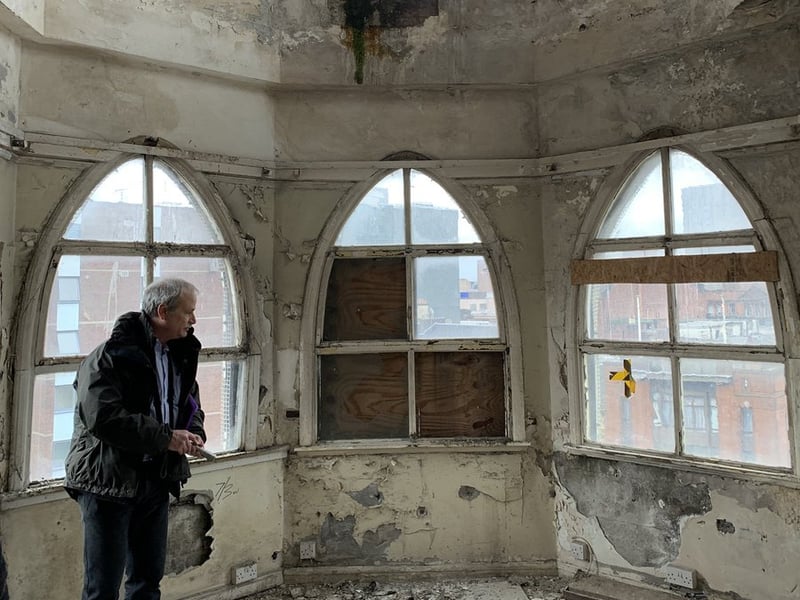
The Lion Chambers towers above Hope Street at the corner with Bath Lane in Glasgow city centre. It was commissioned by William George Black, a lawyer and member of the Glasgow Art Club with strong connections to the city’s cultural life. The building was conceived as a modern, innovative commercial tower: legal offices on the lower levels, with art studio space above. This unusual combination informed the design with large, sweeping windows on the higher floors to provide light for creativity.
Work began in 1904 and the building was completed in 1907. The architect was James Salmon Jnr of Salmon, Son & Gillespie, who was involved in other Glasgow Style and Art Nouveau landmarks at the time. It’s early use of reinforced concrete associated with the Hennebique system, a pioneering approach to ferroconcrete, added to its significance while sowing the seeds of its demise.
Lion Chambers was designated a Category A listed building in 1966, placing it in the highest tier of statutory protection in Scotland due to national or international importance.
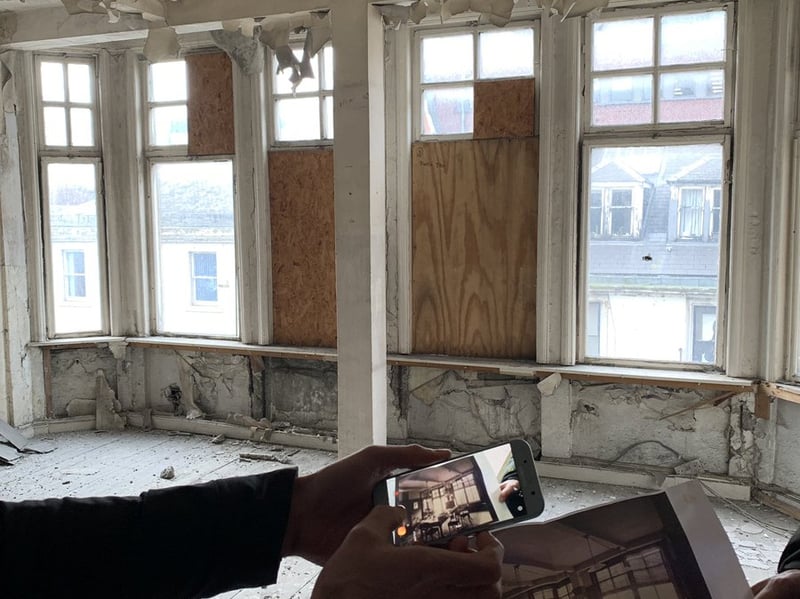
By the 1990s the building’s condition had deteriorated significantly, prompting repeated concern about fabric loss and public safety. Various proposals and feasibility work explored options for repair and reuse, and the building has long featured on at-risk registers, reflecting chronic difficulty in assembling a viable funding and delivery plan for comprehensive restoration. A dangerous buildings order was served in 1991 over the next four years the upper floors were closed.
Public-safety interventions, such as external protection works to mitigate the risk of falling debris, became part of the building’s story as decline progressed.
Lion Chambers remains a priority “at risk” case, with continuing attempts to identify a route that can reconcile its engineering demands - reinforced-concrete repair, weathering and water management, fabric conservation - with a financially sustainable new use. Most recently, it has also been discussed in the context of mechanisms aimed at enabling transfer of long-term vacant property.
Scott Abercrombie, Associate Director at John Gilbert Architects, visited Lion Chambers in 2019 alongside the Four Acres Trust and other conservation workers, providing a rare glimpse inside the structure.
At the time he said that structural issues could be rectified, “but there is a pretty significant conservation deficit (money required : end value of the property) alongside other issues like the complex ownership structure that are factors.”
Pigeons that have invaded the upper floors bring their own problems. Lead has been stolen from the roof. Windows are missing and graffiti has appeared on the exterior. Could the significant, persistent problems be overcome? “Cash is king”, John said.
As a city, Glasgow has important decisions to make in relation to its architectural heritage, this year and in the decades ahead. Protected buildings left to fade away become tombstones to lost opportunity. Whether to put life back into the structures that define our local identity or confine them to history is a choice with a price tag attached and a time limit.

1. Lion Chambers
Lion Chambers in 1975, the building was completed in 1907, designed by James Salmon and John Gaff Gillespie, who together formed the partnership Salmon, Son & Gillespie. | Contributed

2. Lion Chambers
Lion Chambers in the modern day - the office and studio space, occupied mostly by lawyers and artists in its lifetime, were cleared by 1995, declared dangerous for regularly use due to the concrete deteriorating. | Scott Abercrombie
4. Lion Chambers
The upper floors have been empty for decades. The building remains an A-listed protected structure. | Scott Abercrombie