
The best theatre shows of 2025: Joyce McMillan picks her highlights
Stages across Scotland were blessed with some powerful productions in 2025 but these were the cream of the crop, writes Joyce McMillan
The Merchant of Venice, Lyceum Theatre, Edinburgh, January Set in the near future, Arin Arbus’s production of The Merchant of Venice from the Theatre For A New Audience in New York plays out on an austere and anonymous flight of grey steps. At the centre of the drama stands John Douglas Thompson’s Shylock, a figure who carries in his words and body both the full depth of Shakeapeare’s portrayal of the Jewish moneylender and the wider history of racism as it bears down on black Americans. It is a remarkable performance, combining detailed attention to Shakespeare’s poetry with passionate critical exploration of the questions raised by the play.
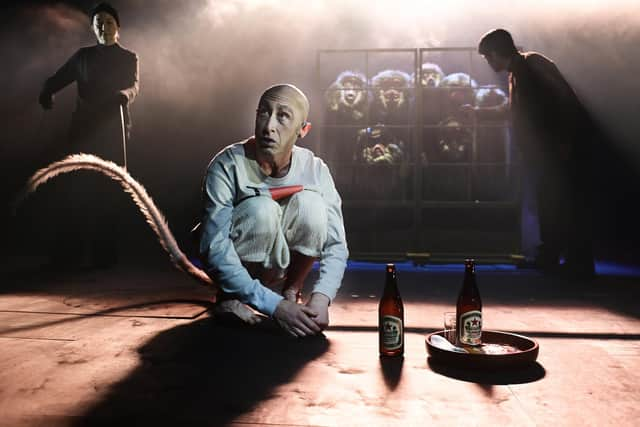

Confessions of a Shinagawa Monkey, Tramway, Glasgow, February Co-created by Vanishing Point and the Kanagawa Arts Theatre of Japan, Confessions of a Shinagawa Monkey is performed in English and Japanese, and it begins with a Japanese writer at lunch with his editor. In the middle of lunch, the editor suddenly realises that she has forgotten her own name; and so begins a story that also involves a young Tokyo married lady called Mizuki who is experiencing similar problems, and a strange central encounter between the writer and a talking monkey. The compelling strength of this 100 minute story depends on the huge depth and energy of the three central performances: from an impressively poised Yuya Tanaka as the writer, a wonderful Rin Nasu as Mizuki, and a breathtakingly subtle, wise and poignant Sandy Grierson as the monkey.
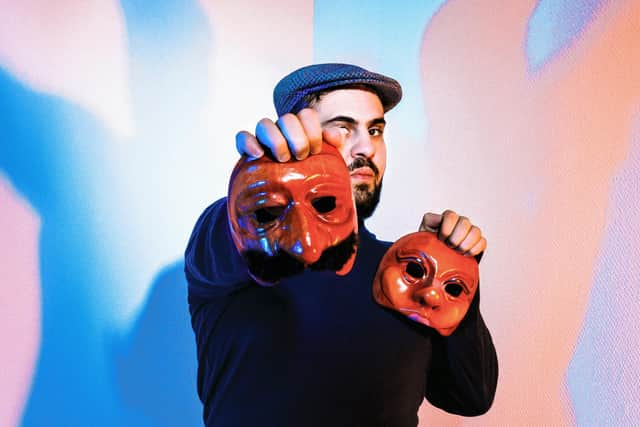
The Horse of Jenin, Pleasance Dome, August Produced by Troupe Courage for the Pleasance and the Palestine Comedy Club, Alaa Shehada’s The Horse of Jenin hits exactly the right balance of life-enhancing comedy and utter tragedy. In 70 minutes of theatre, storytelling and wild, hilarious comedy, Shehada confronts the current crisis in the Israel-Palestine conflict not directly, but through the story of his youth and childhood in the West Bank city of Jenin, home to generations of displaced Palestinians. At the heart of the story is the image of the Horse of Jenin, a 15-foot sculpture created out of war debris in 2003, after a previous Israeli Defence Force (IDF) incursion into the West Bank, which eventually took its place at the centre of a traffic roundabout, until it was bulldozed and removed by the IDF in 2023.
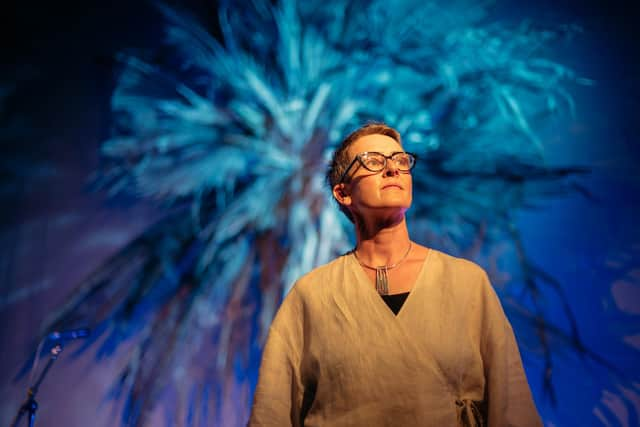
Windblown, Queen’s Hall, Edinburgh, August In her latest show Windblown, Karine Polwart’s subject is the mighty Sabal palm tree that once stood at the centre of the tropical glass house in Edinburgh’s Royal Botanic Garden, but that finally had to be taken down in 2021, too old and unstable to survive the temporary removal of all the plants from the 19th century building, to allow for a major refurbishment. Polwart was artist in residence at the Botanics at the time, inspired to honour and celebrate the old tree, as it faced its inevitable end; and the result is an exquisite 60-minute song cycle, with linking narrative, in which Polwart reflects on the history of a tree that was brought to Scotland from Bermuda as a seed or sapling around 1800.
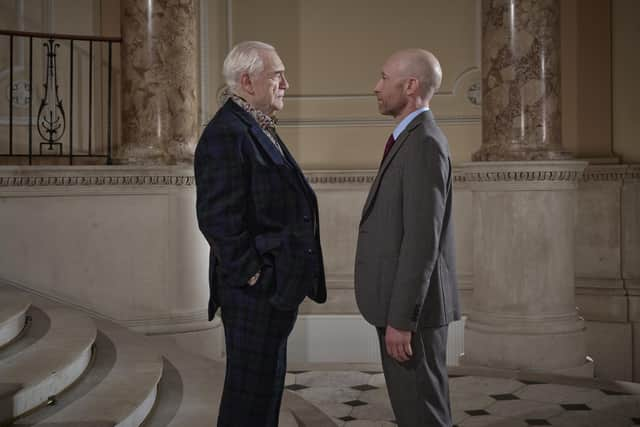
Make It Happen, Festival Theatre, Edinburgh, August Andrew Panton’s production of James Graham’s new play Make It Happen – co-produced by Dundee Rep, the Edinburgh International Festival and the National Theatre of Scotland – is big, spectacular and ambitious from the outset. Its theme is the rise and fall of Fred Goodwin, the Royal Bank of Scotland boss who, around the turn of millennium, first built up the bank into one of the largest corporations in the world, and then saw his world collapse in the great financial crash of 2008, partly triggered by RBS’s colossal debts. It sets its essential confrontation between Goodwin and the long-dead moral philosopher Adam Smith – played in terrific style by Sandy Grierson and Brian Cox – against a backdrop peopled by a chorus of 14 powerful Scottish actors, who not only sing and move impressively as a group, but also provide the cast of other characters who help shape the story.
Small Acts of Love, Citizens Theatre, September We know – in the words of the Czech poet Milan Kundera – that the struggle of humanity against power is the struggle of memory against forgetting. It’s therefore tremendously moving, at this bleak moment in history, to see the gloriously restored Citizens’ Theatre of Glasgow reopen its doors – after a mighty seven-year rebuilding project – with Small Acts Of Love, a collective act of memory about the aftermath of the 1988 Lockerbie bombing of Pan Am flight 103, based by writer Frances Poet and composer-songwriter Ricky Ross on years of meticulous and loving research, and dozens of interviews with Lockerbie people and bereaved families. Dominic Hill’s quietly brilliant production rises in every way to the challenges posed by the story.
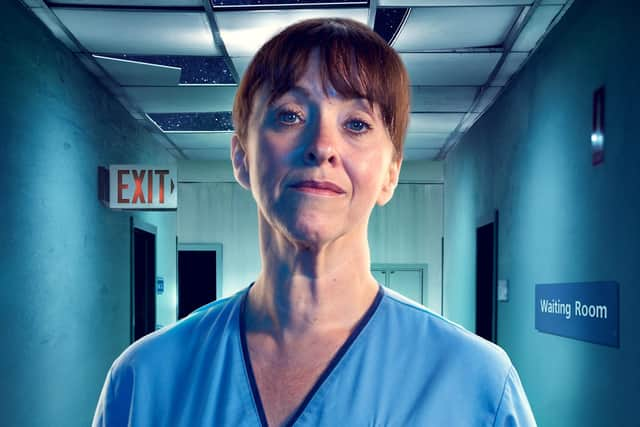
Black Hole Sign, Tron Theatre, Glasgow, September Set in a stressed-out NHS accident and emergency department where a large hole has just appeared in the ceiling, Uma Nada-Rajah’s play seems in many ways like an elegy for an NHS ideal of universal care that is slowly bleeding to death after years of underfunding; and in a single 90-minute movement, her central narrative charts the end of a nursing career built around the fulfilment of that post-war promise. Yet Nada-Rajah – who is herself a critical care staff nurse in the NHS – cannot help also observing, and recording, the sheer vitality and intensity of human experience that still persists in the NHS, and the remarkable enduring strength of an idea that millions still cherish. Helen Logan gives what might be the performance of her life as dedicated but exhausted charge nurse Crea.
The Seagull, Lyceum Theatre, October James Brining’s opening production as artistic director of the Lyceum Theatre is a version of Chekhov’s 1896 play The Seagull that is as funny as it is moving, and completely absorbing, throughout its two hours and 40 minutes. Mike Poulton’s version of the text is brilliantly vibrant, witty and speakable for 21st century actors, responding strongly to Chekhov’s vein of genial yet hard-hitting humour. And at the centre of this production stands Lorn Macdonald’s powerful and heartbreaking performance as Konstantin, the brutally unhappy son of ageing actress Arkadina; a portrait of a young man cruelly let down by a self-indulgent older generation, that might have been written for our time.
Arlington, Tron Theatre, Glasgow, October When Enda Walsh’s Arlington premiered in Galway in 2016, veteran critic Michael Billington hailed it as “a new form of category-defying theatre”; and it remains so nine years on, in this stunning new production by Glasgow-based dance company Shotput. In a dystopian future in which the limits are imposed from above, and a young woman called Isla inhabits a bleak room in an anonymous tower block, waiting for her number to be called by an electronic ticker on the wall. Isla’s number comes up, the scene fades to black., and when the light returns we are in another dimension, where dancer Jack Anderson delivers a jagged, twitchy and riveting 30-minute solo which seems inspired by themes of confinement, struggle and survival. Arlington is designed, of course, to raise more questions than it answers. Yet its image of world of total alienation and control, where human beings are all either “keepers” or “kept”, lingers in the mind like a warning dream.
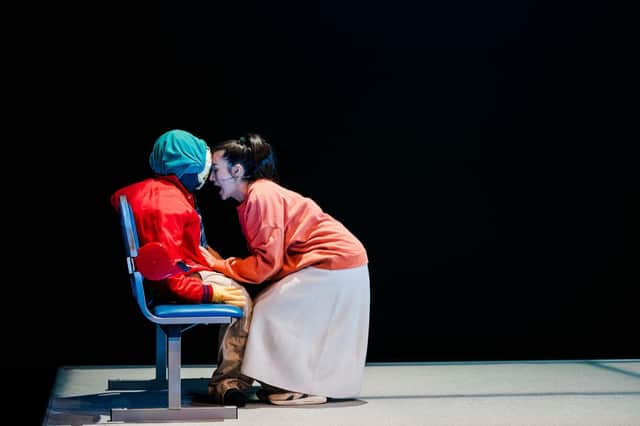
The Last Supper, Tramway, Glasgow, October On the main stage at the Tramway, something wild is happening. Beneath an image of Da Vinci’s great wall painting of the Last Supper, a group of fearless Brazilian theatre-makers from Sao Paulo are gathered; a company called Mexa, founded 13 years ago following a wave of gender violence across homeless hostels in the city. Their show partly evolves as a slightly infuriating act of continuous self-reflection. There are substantial chunks of film from their rehearsal room going back to 2012, reflections on the fights with the group, and one live punch-up on stage, with glittery dresses and bridal veils flying. Through it all, though, The Last Supper never loses its grasp on the sheer thrill of theatre that is fully alive; evolving in front of the audience like a car-crash family party.
The Scotsman’s arts newsletter is now sent twice a week - subscribe today
Want the latest Scottish headlines sent directly to your phone? Sign up to our new WhatsApp channel here.
Comments
Want to join the conversation? Please or to comment on this article.