
Martin O'Connor and Len Pennie on the Scots language: 'People get ragin at you'
In his National Theatre of Scotland show Through the Shortbread Tin, Martin O’Connor sets out to debunk lazy stereotypes about Scotland via the story of 18th century poet James Macpherson and the Ossian ‘hoax’. As he prepares to bring the show to the Edinburgh Fringe, he talks to poet Len Pennie about ‘all stuff Scots language’
Martin: Hi, I'm Martin O'Connor. I'm the writer and performer of Through the Shortbread Tin, and I'm joined today by Len Pennie. And today we're gonnae talk all stuff Scots language.
Martin - What shall we talk about?
Len - Well, what is Scots to you?
Martin - What is Scots to me?
Len - It’s a difficult question, isn't it?
Martin - Well, it is difficult because it's inherent, right? And it's kind of hidden, and it's obviously somethin that's tied up with your upbringin and your childhood and your family and then the context you're livin and workin in. But it's complicated.
Len - It is.
Martin - Why is it so complicated?
Len - There's, for me at least, a hybridity when it comes to identity because, as you say, there's how you grew up, and then there's that space where you leave your hoose, and you've tae interact wi people who speak differently, think differently, have different opinions. And dependin on how you were raised, it can either confirm your thoughts aboot Scots or just blow it wide open.
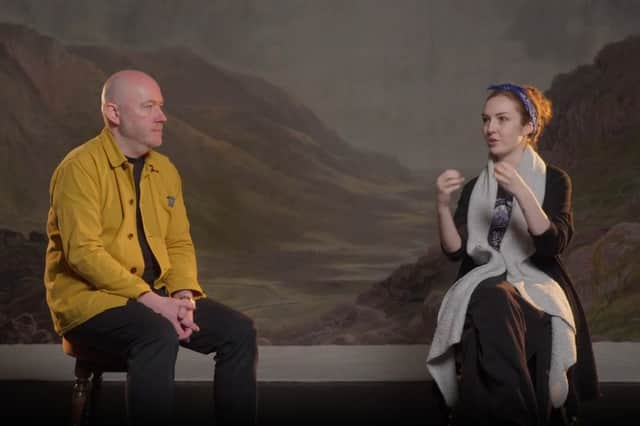

Martin - That was ma experience because... growin up in Glasgow and speakin the way that I was speakin…. I suddenly went to college. and I knew then, day one, I knew it. I had to change the way that I spoke, in order to be understood or in order to be taken seriously was probably what I was really feelin'. I had voice lessons to change the way that I spoke… and, and it worked. Because they believed, they believed back then that you had to no have an accent, if you were gonnae do other accents. So, if I was gonnae learn to be an actor, I needed to have some sort of, like, clean slate.
Len - Oh, the one neutral accent...
Martin - 'Cause you can't be Scottish.
Len - That's it. But see, the accent that they were teachin you tae do, that's an accent.
Martin - Exactly.
Len - Even received pronunciation is an accent. But there's this idea, I think, that there's a neutral, a linguistic neutral, an accent neutral, and then everythin else is supposed to be goin towards that. And when it comes to Scots, that's even more annoyin because it's very easy to shame people and make them speak differently, and it doesn't erase that part o you, but it sits there, and it's still there, but you miss it. And then whenever you try and access that in your work or in your life, it feels authentic... sometimes. But then, again, that hybridity, you feel inauthentic because it feels like you're puttin it on 'cause you try and ignore it.

Martin - Yeah. That's it. That's really interestin because when I started doin poetry and spoken word and makin ma ain theatre and writin ma ain theatre projects, I knew I wanted to do somethin in what was my ain language, but I, you know, whatever that was from ma childhood. And then just feelin completely inauthentic about it because I'd changed so much, and then you're tryin tae reclaim this thing or recreate it in some way. and it just feels like you're makin it up. Or you're at it. Do you feel like that as well?
Len – Honestly and I'm telt all the time that I'm at it. They’re like, "Oh, you're at it. You don't speak like that." But the thing is, when I go home and speak to ma mum, it feels natural. It feels normal.
Martin – Absolutely
Len – Because that's the language I was mothered in. But then you come oot the hoose, and it's like, oh, this feels, this feels performative because I think there's bin a complete 180 when it comes to Scots, where everyone's goin, "We have a legal responsibility to include Scots, to include Gaelic, to, show that we're not, you know, perpetuatin this attempted eradication. And then you run the risk o bein tokenized because then you run the risk of bein the only, you know, Scots speaker that code switches oot o it. So, in the meetins you can conduct yourself properly. But then when it comes to writin somethin or performin somethin oh, we can switch intae it.
Martin - You're sayin performative, do you not think it is helpful? Like, I've found it helpful. So, the poetry and the art for me has been the outlet for me tae be able tae do the Scots. So, callin it performative actually does work if you're in that opportunity to perform in the language.
Len - Because, people will see your work and think, "Oh, I can write in Scots. I can use Scots." And I just wish that we could take it intae the meetins before the performance. 'Cause I'm very privileged in the sense that I get to write and perform ma own work, so I get to choose when I use Scots and when I don't. But a lot of people are havin to perform Scots that isnae theirs. Because obviously there's no standard. And if we were to say, all right, you know, Jimmy makes a standard, where's he fae? Is his language gonna look like mine? So, it's difficult. It's really difficult. And then also a lot o people that are usin Scots professionally have been educated out of it, have been telt that it's no the right way to speak. And in that sense, there's an unlearnin and a relearnin that has to take place.
Martin - That's it. So now ma Scots is a completely different version of what it woulda been had I just kinda stayed where I stayed and lived where I lived and just kept speakin that way. But, really interestin you say that aboot, like, even performin, bein felt like you have to perform in a certain type o' Scots in the right way as well. I totally get that. So all the work that I've done, I've written things but as soon as I'm learnin ma lines, as soon as it's oot ma mouth, I'm like, "But would I say it like that?" And if I don't say it like that, then it goes. Or I cut it, and it just gets even simpler. Do you know what I mean?
Len - I add a lot - I do a wee bit o linguistic magpiery, and I go round all the different dialects o Scots that I didnae use growin up. And I'll take fun words because... well, you would do that with English.
Martin - Well, o course, you'd do that wi any language.
Len - But you'd never do that with Scots...
Martin – So, can I do that, please? Can I have your permission to do that?
Len - That's the thing. I'm not gonna claim to be an expert in Scots, but I'm a massive nerd, and I've noticed that happenin in other languages. But in Scots, because it's fragmented, it's dialectal in nature, it's very regional. People get ragin at you. Like, people from Glasgow will say, "Oh, we dinnae say 'ken' in Glasgow." But then you look historically and it's there. Post-World War II it's in Glasgow. So, at some point Glasgow decided "we don't use ken" and then that's just an absolute riddy if you use it. But I'm a big fan of the idea that you can only ever augment your language. And I think that just if you like a word, use it. If you dinna, don't.
Through the Shortbread Tin is at the Scottish Storytelling Centre, Edinburgh, from 6-31 August as part of the Edinburgh Festival Fringe. This is an edited transcript of a filmed conversation between Martin O'Connor and Len Pennie. To watch the first ten minutes, see above. To watch the whole 30 minutes, visit www.nationaltheatrescotland.com
The Scotsman’s arts newsletter is now sent twice a week - subscribe today
Enjoying the Arts & Culture journalism on scotsman.com? Make it easier to find by selecting us as a preferred Google source
Want the latest Scottish headlines sent directly to your phone? Sign up to our new WhatsApp channel here
Comments
Want to join the conversation? Please or to comment on this article.