
‘We create an invisible conductor' – violinist Lorenza Borrani on leading the SCO
In the coming weeks, Lorenza Borrani will direct a series of SCO concerts from a front-row seat in the first violins. ‘What I love about working in this way is the amount of learning everyone gains,’ she tells David Kettle
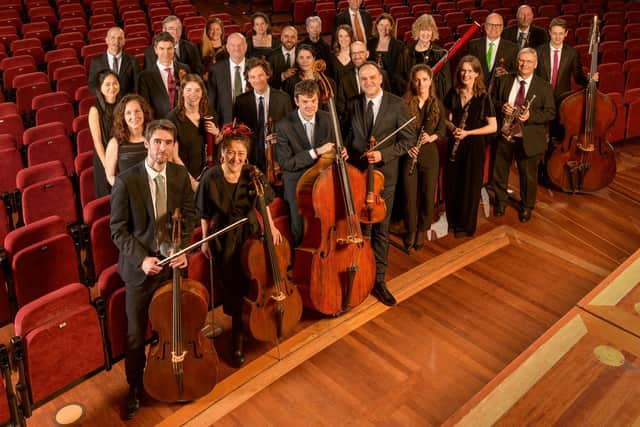
The middle word in the Scottish Chamber Orchestra’s name is, of course, crucial. On one level, it’s simply musical shorthand that they’re a bijou, compact ensemble of a few dozen players – smaller, certainly, than their heftier symphony orchestra counterparts. What it doesn’t mean is that they play chamber music (even if they actually do, but as a sideline, and only in even smaller combinations of quartets, quintets and so on). Nonetheless, on another level, the thinking behind chamber music – of closeness and collaboration, of musical intimacy, of a profound awareness of other players’ roles and contributions – is fundamental to each musician’s activities as part of the orchestra.
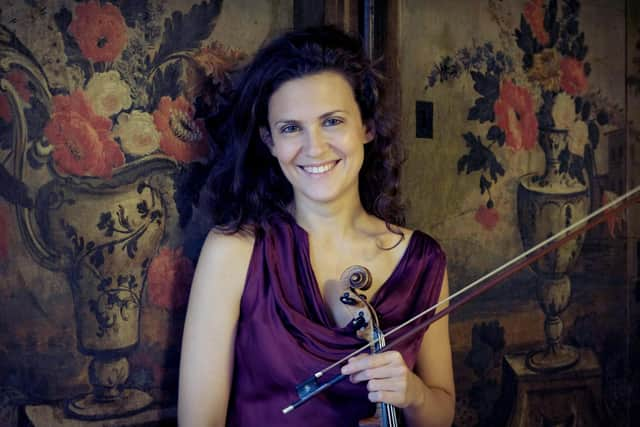

It’s something that comes even more strongly into focus in two groups of early spring concerts that the SCO is due to give with violinist and director Lorenza Borrani, who’ll be directing the performances from her front-row seat in the first violins. It’s far from the first time that the SCO has worked in this way, of course, but directing from the leader’s chair is something that Borrani clearly feels particularly passionately about. “I like to think of the role as similar to when, in a play, the theatre director is also one of the actors,” she says. “They have a leadership role during rehearsals, but once the shape of the piece is created, it becomes a matter of sharing responsibilities and roles. Everyone has to be personally involved and can express themselves freely within the framework that’s been created during the rehearsal process. The effect is a very special – perhaps deeper, or simply different – level of commitment from each individual musician.”
It’s also a role-straddling position that Borrani has long specialised in. She’s been leader/director of the eminent Chamber Orchestra of Europe for many years, and also has similar roles with Norway’s Arctic Philharmonic Orchestra and Sweden’s Västerås Sinfonietta. And with her own ensemble, Spira Mirabilis, she’s even performed such gargantuan creations as Mozart’s The Marriage of Figaro and Beethoven’s Ninth Symphony entirely conductor-less. “What I love about working in this way is the amount of learning everyone gains,” Borrani continues. “We learn from each other, inspire each other, creating something like an invisible conductor that guides us. This invisible conductor is the idea or interpretation we ourselves build of the piece.”
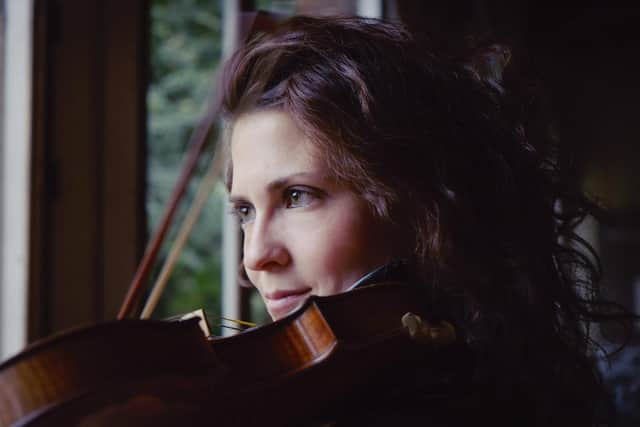
There are, however, undeniable challenges to this way of working – as well as perhaps unusual demands on an orchestra’s musicians. “In order to feel free when playing, it’s fundamental that everyone has internalised the complete score, with all the different responsibilities at different moments,” Borrani explains. “That way, things can also be spontaneous in performance, because everyone is ready to react.”
An “invisible conductor” can – paradoxically – also have an effect on audience perceptions, Borrani feels. “Reactions can vary. Some listeners become more critical and, feeling less secure because of the absence of a conductor, may notice issues. More often, however, listeners feel involved in this attitude of sharing that the musicians bring to the stage, and might even say they’ve discovered a new way of listening.”
That new way of listening might be particularly welcome in Borrani’s first SCO concerts, coming up in mid-January. They’re bookended by symphonies by Haydn and Schubert (the much-loved but still slightly mysterious “Unfinished”), but in the middle is a far less familiar work: the Concerto grosso No. 1 by Soviet composer Alfred Schnittke. For many, he’s the natural successor to Shostakovich, and he’s most famous (or perhaps notorious is a better word) for hurling together wildly contrasting musical styles within the same piece. In the case of the Concerto grosso No. 1, that ranges from Vivaldi-style exuberance to modernist dissonance to foot-tapping tango. Borrani will be one of the piece’s two violin soloists.
“It’s a perfect example of Schnittke’s love for musical contamination and reflection on the past,” she explains. “His music feels like an old cathedral standing among skyscrapers, with some broken parts replaced by fragments from other buildings, but in a nostalgic and deeply poetic way. That’s the feeling I get, anyway.”
There’s another mix of old and new (or, perhaps more accurately, older and newer) in Borrani’s March concerts, which bring together Beethoven’s witty Eighth Symphony and Britten’s luminous Variations on a Theme by Frank Bridge. That tots up as three iconic composers from the turn of the 18th and 19th centuries. Another facet of Borrani’s musical outlook is period performance: she was steeped in issues of historical authenticity during many years working with the revered conductor Nikolaus Harnoncourt at the Chamber Orchestra of Europe. We've come a long way from hardline attitudes towards authenticity during the 1970s and 1980s, however: where does she feel we are now?
“Someone like Harnoncourt managed to ‘contaminate’ a wide spectrum of musicians with this approach and research, awakening curiosity about performance practice among modern players,” she explains.
“Research and study help us to perceive more of music’s ‘unwritten’ dimension. That said, it’s impossible to feel fully confident about being historically ‘true’ or ‘correct’. Every musician can educate their own instinct, but every instinct is different. In the end, it’s up to the musician to decide what helps them feel closer to their idea of the music and express it at its best. To reach an audience, it must feel authentic.”
It’s surely an approach that chimes harmoniously with the SCO’s own flexible but pragmatic perspective, which brings out historically appropriate varieties of certain instruments but elsewhere simply adapts playing techniques. In that respect, says Borrani, “I feel we speak a very similar musical language.”
Indeed, she’s fast becoming a regular SCO collaborator: she made her debut with the Orchestra in 2024, and is back for two lots of concerts this year. How important are these kinds of longer-term musical relationships to her?
“‘Important’ isn’t enough – they’re fundamental,” she says. “Project by project, we can build stronger musical trust. Each time, we can take another step deeper into our musical explorations, and the development of human connection that makes rehearsal and concert time part of the experiences that enrich our lives. Listening to a piece or studying a score is one thing. Being inside it and part of it is something entirely different. I believe that anyone fortunate enough to play an instrument should try and experience everything it can offer. We’re incredibly lucky.”
Lorenza Borrani directs the SCO in music by Haydn, Schnittke and Schubert at the Queen’s Hall, Edinburgh, 15 January, the City Halls, Glasgow, 16 January and Easterbrook Hall, Dumfries, 17 January. She also directs the orchestra in works by Rossini, Beethoven and Britten at the Queen’s Hall, Edinburgh, 5 March and the City Halls, Glasgow, 6 March, see www.sco.org.uk This feature was produced in association with the SCO
As part of our ongoing media partnership with the Scottish Chamber Orchestra, we’re offering 20 per cent off tickets to concerts in the SCO’s 2025/26 season. All you need to do is quote the code TSMSCO20 when booking – for venue contact details visit www.sco.org.uk. Offer subject to availability.
Comments
Want to join the conversation? Please or to comment on this article.