
Soprano Carolyn Sampson to take a starring role in SCO's new season
Following a memorable BBC Proms performance with the SCO last summer, Carolyn Sampson will feature prominently in the orchestra’s upcoming season, writes David Kettle
“I never know how honest to be in interviews,” soprano Carolyn Sampson admits. “But to be frank, I sometimes struggle slightly with Beethoven.” It’s understandable that one of Britain’s most respected and versatile singers is perhaps slightly hesitant about confessing her concerns. Especially when she’ll be performing one of the composer in question’s most monumental and profoundly spiritual works – the mighty Missa solemnis – as one of the highpoints of the Scottish Chamber Orchestra’s 2026-7 season.
“If I’m going to listen to a concert, I don’t necessarily think I’m going to love Beethoven’s music,” she continues, “but what always surprises me is that there’s invariably something that draws me in, quite often a slow movement. He writes moments of such beauty – in the Missa solemnis, the Benedictus movement that I sing with the solo violin is so tender. It’s just magical.”


Beethoven’s Missa solemnis is just one of four performances that Sampson gives with the SCO during its upcoming season. She’s very much a featured artist next year, following several earlier performances with the orchestra, including a memorable Mendelssohn Elijah in both Scotland and at the BBC Proms with Principal Conductor Maxim Emelyanychev. “There are certain groups throughout my career who have really looked after me in terms of giving me opportunities, and the SCO is one of them,” she smiles. “And consequently, I also feel a great loyalty to them. It’s special because, on a human level, you feel valued, which is obviously a nice thing. But I think it fosters trust, which then definitely translates into the music making.”
The Beethoven monolith undoubtedly represents the biggest and grandest of Sampson’s four performances. It forms a highpoint in the SCO’s season-long celebration of the composer, marking the 200th anniversary of his death, which also takes in several symphonies, piano concertos from Sunwook Kim, the Violin Concerto from Pekka Kuusisto, and even a deconstruction of the composer’s ballet music for The Creatures of Prometheus alongside offerings from Viennese mischief-maker HK Gruber.

Another of Sampson’s highlights, however, is sure to be Poulenc’s opera La voix humaine, in which she’ll be the sole protagonist, a woman who sees her life crumble around her during a final, devastating phone call from her lover. The piece might only last 40 minutes, but it packs a mighty punch – and it’s an opera that Sampson has long wanted to perform. “I did a project with the Dunedin Consort in Scotland, and Maxim came to hear it in Glasgow. He caught the train back with us, and I was chatting to him about this and that. I mentioned that I’d love to perform La voix humaine. That was clearly a useful conversation!” Performances aren’t scheduled until March 2027, but have there been discussions about a possible staging? “We’ve talked about having a phone, maybe a chair or a sofa. But we’ve got to be practical – the performance has got to make it to two different venues.”
The French theme continues in the third of Sampson’s four performances, a matinée chamber concert including Chausson’s Chanson perpétuelle and Fauré’s La bonne chanson. “I had quite a big say in that one – I made lots of suggestions for repertoire. But the great thing about the SCO is that it’s a real chamber orchestra, and you can do these smaller things too – proper chamber music.” The scale expands again for the first of Sampson’s concerts, Mendelssohn’s mighty Lobgesang in November.
The closeness of connection that Sampson clearly feels with the SCO is crucial on another level too, she explains. “I hate practising on my own, in any piece of music. It never makes sense until I’ve got everyone with me. I just like making music with other people.” Sampson has particularly strong relationships with Emelyanychev and SCO Principal Guest Conductor Andrew Manze, both of whom will be directing her performances next season, and has collaborated with both men away from the SCO too.
“Maxim’s very loyal to his collaborators – I think once he’s found a team he likes, he tends to stay with them, which is great for me if I’m part of that team. I suppose for me, the crucial thing about working with any conductor is respect for someone’s musicianship, which works both ways. In some pieces, I’m the only soloist, so I’ll have more say in things, but in others it’s simply not my musical journey – I’m coming along for the ride on their musical journeys.”
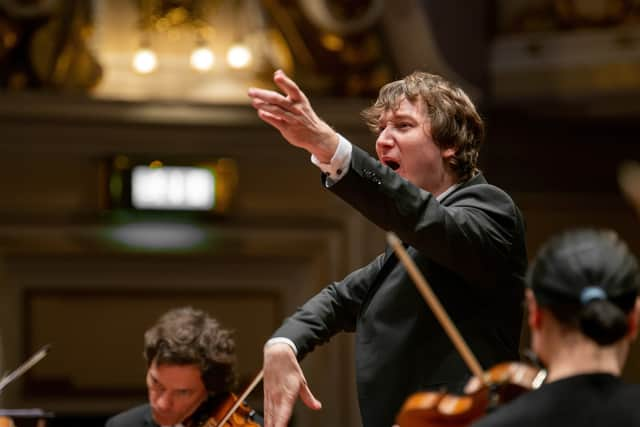
Emelyanychev and Manze are very different musicians, with contrasting but complementary approaches to working with the SCO. But Sampson sees similarities between them. “I think they both like to let the music live in the moment.” That can mean spontaneity, even unpredictability in performance, but, says Sampson, “that comes down to trust again. And I like that way of doing things.”
In many ways, Sampson’s quartet of concerts – ranging from monumental Beethoven to Poulenc’s portrait of a woman on a verge of a nervous breakdown – is itself a microcosm of the breadth and diversity of the SCO’s new season overall. Anyone who still thinks the orchestra’s all about Haydn and Mozart is likely to be somewhat shocked. Yes, there’s early Classical music from superb period violinist Rachel Podger and Schubert from Parisian hotshot Raphaël Pichon, but there’s also Max Richter’s reimagining of Vivaldi’s Four Seasons and a brand new concerto for string quartet and orchestra from Nico Muhly, with pioneering New York ensemble Brooklyn Rider as soloists.
But if the new season’s repertoire is gratifyingly broad, then the same goes for the SCO’s activities overall. The more informal, more forward-facing New Dimensions concert strand continues into its third year, while there’s a renewed focus on the restorative power of music with concert tickets offered to ease loneliness, boost wellbeing and support positive health outcomes, and special concerts and workshops for people living with dementia. It might mark a shift away from music for music’s own sake, but if bringing yourself into contact with live music leads to greater wellbeing, then surely that’s something worth harnessing. And surely it’s also a sign of an orchestra redefining its position and purpose to respond to contemporary needs – and just one part of what looks to be a full and fulfilling new season.
For full details of the SCO’s 2026/27 Season, visit www.sco.org.uk. This feature was produced in association with the SCO
The Scotsman’s arts newsletter is now sent twice a week - subscribe today
Want the latest Scottish headlines sent directly to your phone? Sign up to our new WhatsApp channel here
Comments
Want to join the conversation? Please or to comment on this article.