
Scottish Opera: The Marriage of Figaro, Glasgow review: 'plenty to provoke'
The freshness of this production is due in large part to its excellent cast, writes David Kettle


The Marriage of Figaro, Theatre Royal Glasgow ★★★★
Sir Thomas Allen’s production of Mozart’s The Marriage of Figaro is fast becoming a Scottish Opera warhorse. Well, “fast” might be overdoing it: it’s been a decade since the show was last seen on Scottish stages, even if the 2026 performances represent the production’s third outing since its 2010 unveiling. Crucially, though, it feels as fresh, bracing, funny and provocative as ever.
And even thinking of it as a revival doesn’t feel entirely right. Yes, the sets, costumes and conception remain essentially the same, but the English-language libretto – in a witty, sometimes saucy but unfailingly elegant translation by Amanda Holden, a first for this production – brings a new immediacy to the production, as well as plenty of slippery wordplay. It’s as if we’re thrown into this farcical world of squabbling aristocrats and scheming servants, rather than observing it from a distance.
And the show’s freshness, too, is down in large part to Allen’s excellent cast. His apparently traditional production – all shapely interiors and stately 18th-century costumes – might seem like a missed opportunity to interrogate the text. There are indeed missed opportunities: gardener Antonio (a nicely gruff performance by Francis Church) remains a bumbling yokel complaining about his crushed carnations rather than representing a put-upon servant, for instance. But for the most part, Allen’s historical fidelity allows Mozart and librettist Da Ponte’s often barbed comedy to shine through with a surprising injection of venom.
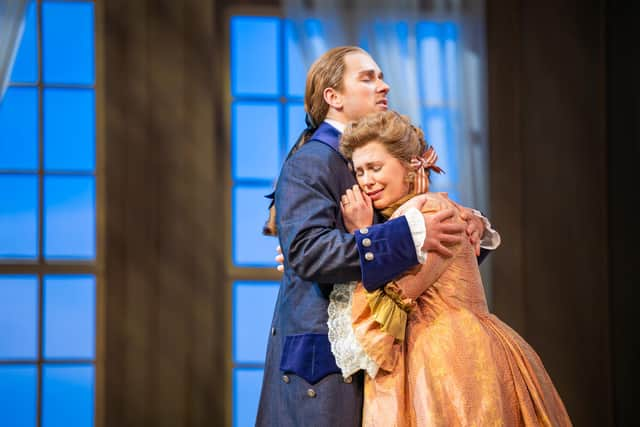
And that venom comes most clearly through the central plotline of bigwig Count Almaviva’s evident intentions to exert his aristocractic privileges and bed maid Susanna on her wedding night, drawing authentic fury and frustration from her intended, Figaro, in a strongly characterised but complex performance from Edward Jowle. Rather than a wily jack-of-all-trades with a scheme to solve everything, Jowle’s Figaro is a convincingly conflicted figure, spitting fury against women and their apparently unfaithful ways, while showing playful tenderness towards his bride-to-be. It’s a fascinating performance – never rejecting comedy, but full of pathos too – and one whose emotional richness is nicely matched by Jowle’s vocal versatility: it might be his first Figaro, but he’s clearly got plenty to say about what’s too often something of a two-dimensional character.
Ian Rucker’s Count, too, shows a fair degree of insecurity behind his swaggering, conveyed in his crisp, agile baritone. Simone McIntosh makes a believably hot-blooded pageboy Cherubino, capturing youthful ardour (and disobedient bodily functions) with eagerness and vulnerability.
But it’s through the production’s two central female characters that Allen summons most sympathy, and directs attention – quietly, though clearly – towards ideas of power and privilege. Ava Dodd is a sparky, go-getting Susanna, clear-headed about her desires and what she needs to achieve them, but with a fractured fragility that sometimes threatens to undermine her determination, and with a beautifully silvery, finely etched soprano that conveys her character’s emotions vividly. Most of all, though, Alexandra Lowe presents a convincingly exhausted, neglected Countess, who’s clearly endured years of her husband’s philandering – captured most movingly in a fleeting glimpse of her younger, more innocent self (just one of the many blink-and-you’ll-miss-them details that add depth to Allen’s production). Lowe’s burnished soprano is an ideal match for the Countess’s churning emotions, hopeful, even vengeful one moment, but resigned the next.
If Allen’s singers are vivid and strongly projected, then so too is the Orchestra of Scottish Opera under conductor Dane Lam, who together deliver a beautifully light-footed but richly detailed account of Mozart’s score. Continuo player Toby Hession, too, has a fine old time adding knowing references and telling sleight of hand into his keyboard accompaniment, at times almost becoming part of the unfolding action himself.
With Simon Higlett’s elegant designs in which the vital garden feels ever present, and under Mark Jonathan’s evocative lighting, it’s a show that has masses to entertain, no shortage of gags, but plenty to prod and provoke too.
On tour, see www.scottishopera.org.uk for dates
The Scotsman’s arts newsletter is now sent twice a week - subscribe today
Want the latest Scottish headlines sent directly to your phone? Sign up to our new WhatsApp channel here
Comments
Want to join the conversation? Please or to comment on this article.