
Ryan Bancroft: 'When you conduct, it should be music you’re in love with'


Ahead of his forthcoming concerts with the SCO, American conductor Ryan Bancroft talks to David Kettle about his love of Sibelius and Greig, the advantages of working with the intimate forces of a chamber orchestra, and why Glasgow is his favourite city in the world
“My husband and I speak twice weekly about moving back up to Scotland,” says Ryan Bancroft. With high-profile positions at the BBC National Orchestra of Wales, Royal Stockholm Philharmonic and Tapiola Sinfonietta, the California-born conductor currently lives in London. It makes a lot of sense in terms of travel, but that isn’t stopping him pondering a move north: “We’ve been looking at how easy it is to get flights between Scotland and Stockholm or Helsinki.”
Scotland clearly occupies a prominent place in Bancroft’s heart, and also in his history. That much will no doubt be evident when he returns to conduct the Scottish Chamber Orchestra for three concerts in early November. He grew up in Los Angeles, and his first musical studies – mainly trumpet, but also harp, flute, cello, and Ghanaian music and dance – were at the California Institute of the Arts on the city’s outskirts. However, the two years he spent at Glasgow’s Royal Conservatoire of Scotland doing a master’s degree in conducting represented a change in direction, both professionally and personally. “It was the first – and probably the greatest – adventure of my life,” he smiles. “I mean, being from South LA, born into a family that really didn’t have much means, never in a million years would I have thought that I’d go to Scotland – it was about as exotic as it got to me at the time.”
He still names Glasgow as his favourite city in the world. “And I’ve now been all over the place.” Why is that? There are the opportunities offered by the city’s vibrant music scene, and the openness of its people – not for nothing does Bancroft describe himself as a people person. But there’s a more personal reason, too. “It was my first taste of being in a place where nobody knew who I was, of being truly anonymous. In LA, everyone knew me. My oldest brother is AJ, so I was always AJ’s little brother. When I moved, I had my own agency – I could create a new reality for myself.”
That sense of starting afresh, on his own terms and with his own aims and purpose, is clearly central to Bancroft’s outlook. And his disarming frankness – hardly common among professional classical musicians – surely comes from a place of self-knowledge, and of feeling deeply comfortable in his own skin.
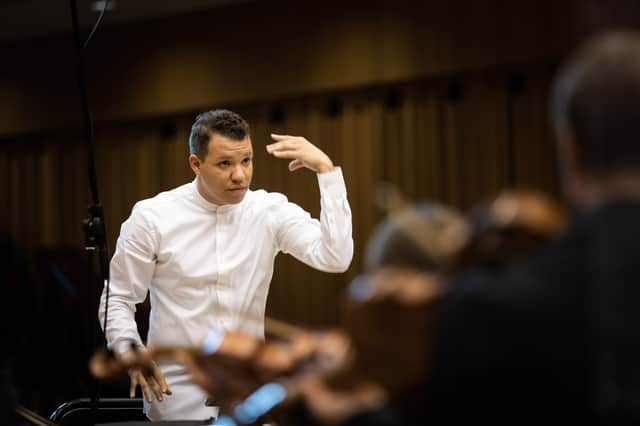
With a burgeoning international career, Bancroft has plenty to feel comfortable about. He threw himself into the opportunities he saw during his years in Scotland, too, joining the BBC Scottish Symphony Orchestra on trumpet on several occasions, as well as conducting ensembles in Scotland and the north of England. And he has vivid memories of the SCO.
“There were so many firsts. I remember seeing Steven Isserlis playing the Dvořák Cello Concerto for the first time with the SCO, and Robin Ticciati conducting Haydn symphonies and also a Schumann symphony cycle – that was the birth of my love for both those composers. I saw the most expressive bass playing from Nikita Naumov – it was the first time I’d encountered that in an orchestra.”
Jump forward just a few years, and Bancroft made his own debut conducting the SCO in 2023, in a distinctly American-flavoured programme of Ives’s Three Places in New England and Copland’s Appalachian Spring. “I was really fortunate that that first time was with music that I dearly love,” he chuckles. “As a conductor, that’s always the goal: everywhere you conduct, it should be with music you’re absolutely in love with. To be honest, it’s the one thing I’m really quite militant about. I have to be into it, because if I don’t feel it, I’ll feel like a fraud, and I’ll worry I won’t be able to offer everything I can.”
There’s more of that in this year’s concerts, though America is entirely absent. Instead, Bancroft conducts an all-Nordic programme, based around what are surely two of classical music’s best-loved pieces: Sibelius’s Fifth Symphony and Grieg’s Piano Concerto. With prominent roles in Sweden and Finland, and greater immersion in the music of Europe’s northern countries, is that just a coincidence? “I’ve actually always loved Nordic music,” Bancroft explains, “and I do a lot of it. I think my big break came with winning the Malko Competition for Young Conductors in Copenhagen, and there was lots of Scandinavian music as part of that contest. Danish composer Carl Nielsen has always been the great love of my life, but of course working with a great chamber orchestra in Finland, we get to know Sibelius inside out.”
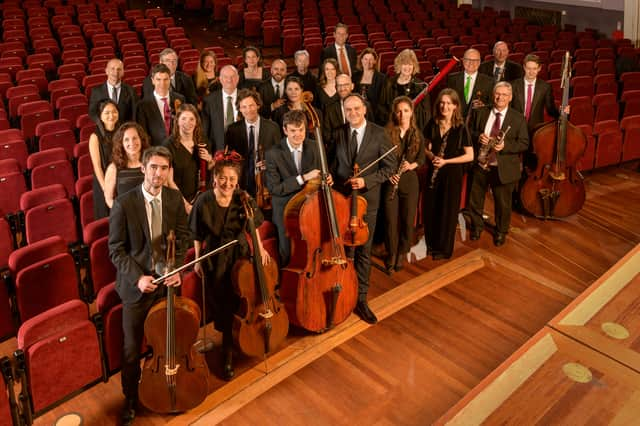
But Sibelius’s Fifth – famously one of the composer’s grandest, noblest utterances – might not be the first piece you’d expect to hear from the intimate forces of a chamber orchestra. “I’ve actually done it with the Tapiola Sinfonietta, and it really does work,” Bancroft smiles. “It’s because of the way Sibelius writes, which requires such a sophisticated level of listening from the musicians. With the famous five-minute speed-up in the first movement, for example, in a symphony orchestra, musicians at the back are craning to see and hear whether they’re still together with the players at the front, who might be 30 metres away. With a chamber orchestra, there are simply fewer people on stage, so it becomes far less scary, and far more of a question of: how far do we want to take this?”
If Sibelius’s Fifth is widely loved, its concert stablemate – Grieg’s Piano Concerto – is positively adored. Doesn’t that bring a sense of responsibility, of living up to listeners’ expectations? “No. And I’ll tell you why,” Bancroft grins. “When I was first really getting started out, I conducted the piece in Oslo with the Norwegian National Opera Orchestra, in their new opera house – another conductor had cancelled, so I was filling in on a few days’ notice. I thought: cool, I’ve never been to Oslo, can’t wait. What they failed to tell me until just before the concert was that it was the Concerto’s 150th anniversary, the first time the piece had been performed in the new hall, and that Grieg’s descendants were in the audience to hear it. So no, I’m not nervous about the expectations of a Scottish audience!”
Perhaps another reason for Bancroft’s sense of calm is his Concerto soloist, fellow American Eric Lu. They’re pretty close: check Lu’s social media and he clearly loves working with Bancroft. “He’s quite a bit younger than me, but I’ve learnt a lot from him,” Bancroft admits. “He has this absolute infatuation with Schubert that I never had until recently. We’ve done a lot of the classics together, like the Beethoven piano concertos. He’s attempting to get me to do the Chopin concertos – which absolutely will not happen.”
That kind of closeness with fellow performers is something musicians often identify as easing rehearsal discussions, facilitating short-cuts, second-guessing each other’s thoughts on interpretation. But Bancroft mentions quite a different additional benefit. “On a very personal level, it allows you to let your guard down. Like I can say to Eric: sorry, I was slowing down there, or I just don’t understand how to do this bit. I can just be honest and open – and I think the performance benefits. The other thing about performing with a friend, though, is that you can mess with each other. Like: how long am I going to make you wait for this entrance? Or how long are you going to make me wait before you launch into your cadenza? Some of these things are a bit like inside jokes, but I think there’s a warmth that audiences pick up on too.” A similar kind of warmth, perhaps, to the one that clearly marks out Bancroft’s own feelings towards his music and the people he makes it with.
Ryan Bancroft conducts the Scottish Chamber Orchestra with Eric Lu (piano) at the Usher Hall, Edinburgh, 7 November; City Halls, Glasgow, 8 November; and the Music Hall, Aberdeen, 9 November, see www.sco.org.uk/events/grieg-piano-concerto
Comments
Want to join the conversation? Please or to comment on this article.