
Pekka Kuusisto and Dreamers' Circus on their plan to 'pollute' Beethoven
What Pekka Kuusisto, folk trio Dreamers’ Circus and the SCO have planned for Beethoven’s Symphony No. 7 might raise a few eyebrows, writes David Kettle
“I suppose the best defence is Beethoven himself, and what we know about him. He wouldn’t be opposed to people having some fun with his music a couple of hundred years later.” It’s revealing that Finnish violinist, conductor, director and musical pioneer Pekka Kuusisto uses the word “defence”. For what he – along with Nordic folk trio Dreamers’ Circus and the Scottish Chamber Orchestra – have planned for Beethoven’s Symphony No. 7 might raise a few eyebrows. Across three March concerts in Edinburgh, Glasgow and Aberdeen, they’ll be merrily melding trad and classical, mixing folk tunes and Beethoven’s symphonic movements, no doubt throwing up connections and contrasts, correlations and collisions.


That’s nothing unusual for Kuusisto, who gleefully disregards what others might consider musical boundaries across classical, folk, jazz, contemporary music and plenty more, and across his many and increasingly influential musical roles. He’ll no doubt bring surprising insights and fresh perspectives – as he’s recently done with his strikingly stripped-back account of classical staple The Lark Ascending on his invigorating new release, Willows.
But the Beethoven project has precedent, too, in the Vivaldi Four Seasons that he performed with the SCO a couple of years back, joined by Swedish cittern player Ale Carr (who also happens to be one third of Dreamers’ Circus) in folk tunes and also forming part of the orchestra’s continuo section. “I was googling ‘basso continuo’ – I had no idea what it was,” laughs Carr. “I discovered it was this kind of accompaniment section in Baroque music, and you can almost improvise what you play. It was definitely an interesting experience.”
The new Beethoven project grew, to some extent, out of the success of the folk-meets-Baroque Four Seasons. “I just remember it seemed almost an automatic idea that trad music should somehow be allowed to pollute the way we approach the Beethoven,” Kuusisto explains wryly. “Pollute” is another loaded word, and there’s an undeniable sense of naughtiness in treating as hallowed a figure as Beethoven in this way. But that, Kuusisto feels, might have more to do with our learning and traditions than it does with the music itself.
“It’s one of those pieces that has a lot of baggage,” he continues, “and there’s such a strong tradition for certain ways of looking at the piece. I don’t think anyone chooses to be stuck in an interpretation they heard when they were young, or something their teachers told them. But I almost wish we could take the red pill, step back, look at the score, and not feel the weight of tradition hanging over it. There’s also a kind of underlying sinister plan, to mutilate the classical music vocabulary we inherit from our predecessors and teachers, and all the peer pressure from dead people in terms of playing styles and approaches.”
There’s a knowing smile in his voice when he puts forward this cunning scheme. But hard distinctions between musical genres are indeed probably more to do with learning and tradition than musical essence. If evidence is needed, just look at Beethoven himself, who made a huge number of sophisticated folksong arrangements (many of them, incidentally, for Edinburgh-based publisher George Thomson). “That was partly during the period when he was writing his Symphony No. 7,” Kuusisto continues. “In fact, one of the folk tune arrangements that Dreamers’ Circus have chosen – the Irish tune Save me from grave and wise – actually quotes the tune of the Symphony’s last movement.”

Blurring conventional boundaries between genres is equally relevant to trio Dreamers’ Circus. Alongside Carr on cittern, it features Danish folk/jazz/pop keyboardist Nikolaj Busk on piano and accordion, and fellow Danish violinist/fiddler Rune Tonsgaard Sørensen, who blends a deep immersion in folk music with roles as concertmaster of the Copenhagen Philharmonic and leader of the much-lauded Danish Quartet. “Our very first performance in Dreamers’ Circus was with the Copenhagen Phil,” remembers Carr. “Rune was playing a Mozart violin concerto, and we did a ten-minute excursion into folk music in the final movement.” They’ve since toured with the same orchestra, and collaborated widely across classical, jazz and pop. “We like to collect inspiration from everywhere we go.”
One of the trio’s biggest sources of inspiration came not from music, but from a meal. “We’d had a very rough touring period and made it out alive, and we decided to book a table at a restaurant called Geranium in Copenhagen. This is new Nordic cuisine – 17 courses across five hours – and they presented local ingredients in a really contemporary way, and the whole arc of the meal really changed something in us.” That sense of using local things in unusual ways, and building something larger from them, seemed to translate into the trio’s musical ambitions. “You can still have a sense of place in the music you play, but then you can take listeners on a longer curve into electronic music, classical music, contemporary music. It’s all about keeping people engaged and surprised.”
For their Beethoven collaboration, that surprise will no doubt extend to the performers themselves: when we speak, it’s still a concept, not yet a concert. “This will be very much a world premiere in every sense,” Carr laughs.
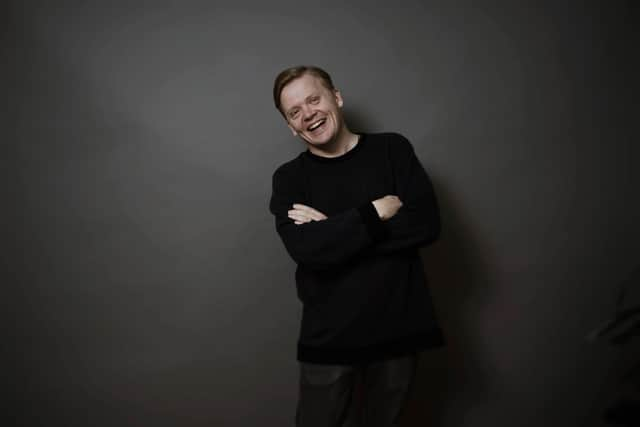
“But I couldn’t hope for a better place and a nicer orchestra to try out such an idea with,” Kuusisto adds. “It’s going to be about not deciding too many things beforehand, but being sure that the things really feel like they need to happen. And that’s a wonderful situation to be in when the orchestra is the SCO.”
For both practical and artistic reasons, both men are understandably tight-lipped about the specifics of the plan they’re hatching. “We’re not planning to interfere too much with the original Beethoven,” Carr admits. “But the music we’ll play will hopefully lead listeners into the Beethoven, and then the other way round too.”
Kuusisto will be wearing several of his many musical hats during the performances. How does he view his role in the project? “Oh, I’m mainly going to be admiring my colleagues,” he laughs. “I’m prepared to wave my arms around in front of the orchestra, and I will almost certainly play some violin. It’s going to feel really stupid not to make any noise myself.”
But as well as providing fresh insights to the audience, it’s also about new discoveries for the players themselves. “The focus shouldn’t just be making the concerts as good as possible,” Kuusisto continues, “but also making sure we all learn from each other. Bringing in musicians like Dreamers’ Circus is a way of including new elements in familiar situations. If you have something familiar like the Beethoven Symphony, and you add something significant that isn’t normally seen in the same room, that might be enough of a disruption to liberate things. We’ll see.”
Pekka Kuusisto, Dreamers’ Circus and the Scottish Chamber Orchestra perform Beethoven’s Symphony No. 7 and folk tunes at the Queen’s Hall, Edinburgh, 19 March; City Halls, Glasgow, 20 March; and Music Hall, Aberdeen, 21 March, see www.sco.org.uk/events/beethoven-pekka-the-dreamers-circus/ This feature was produced in association with the SCO
The Scotsman’s arts newsletter is now sent twice a week - subscribe today
Want the latest Scottish headlines sent directly to your phone? Sign up to our new WhatsApp channel here
Comments
Want to join the conversation? Please or to comment on this article.