
Ones to watch in 2026: Chris Amer, musician
The beguiling folk-jazz soundscapes on Chris Amer’s debut album are inspired by old photographs, writes Jim Gilchrist
Chris Amer’s music is permeated by memory, although the memories involved are not his own. The inspiration for the Glasgow-based guitarist and composer’s first album, due for release on 20 February, came from a collection of photographs taken during the Sixties and Seventies by his Orcadian grandfather, giving him, as he puts it, “a deeply intense experience – like a window into another reality”.
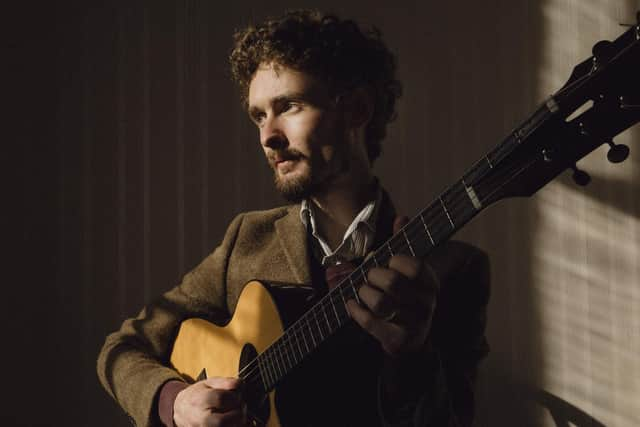

Amer, 31, recorded the album, Making Peace With What Is, largely at home, so it features just himself on guitars, plus drumming on some tracks by Stephen Henderson, drummer with, among other outfits, the Fergus McCreadie Trio. Amer’s previous EP releases were similarly multi-tracked, but now he is relishing venturing more into live performance and touring with other musicians, such as those in the sextet with whom he recently played to a packed house at Edinburgh’s Traverse Theatre as part of the Soundhouse Winter Festival. Touring planned for the coming year, not to mention a forthcoming Celtic Connections gig, should enhance his reputation considerably.
Onstage at the Traverse, Amer cut an intense figure, shifting animatedly in his seat while stooped over either of the two guitars he favours – a distinctive custom-built tenor and a solid-bodied electric. His fellow musicians represented a cross-section of the current formidable young generation of jazz players emerging from Glasgow’s Royal Conservatoire of Scotland (where Amer, an alumnus, is a visiting tutor): pianist McCreadie, bass-guitarist Gus Stirrat, saxophonist Matt Carmichael and violinist Mhairi Marwick.
There’s a beguiling flow to Amer’s music, the bright strings of tenor guitar laced with licks and murmurs of round-toned electric, that defies pigeonholing. “I would say it’s like the harmonic language of folk music but with the improvisatory freedom of jazz,” he says when we meet up some days after the Traverse gig, and he refers to players such as Carmichael and McCreadie, whose jazz prowess can be notably Scots-folk-accented.
”It must be the same for all these guys in that circle, all doing that folk-jazz thing. They’re all my friends and we’re used to just playing and improvising and seeing where it goes.”
At the time of our conversation Amer was about to go into the studio to play on saxophonist Carmichael’s next album and was also due to record with cellist Juliette Lemoine.
“I’m quite a shy person, so it’s maybe taken me a bit longer to poke my head above the parapet and get gigs. That’s why I did this album kind of on my own, then I got Stephen to play drums on the second side of it and I loved that. So I’ve been trying to get out there more and I’ll probably do more ensemble things. I’m really loving playing with all these people.”
Making Peace With What Is he describes as “a rich, memory-infused soundscape”, although, he adds, the memories are not his but those of his grandfather, Danny Nicolson, a joiner and keen amateur photographer in Orkney, whose photographs of everyday life inspired his grandson, prompting “Intense nostalgia for a time period I didn’t live through.”
“Some people are very present minded,” he continues. “I’m more of a mind that is always drifting back, or thinking ahead. So memory’s always been quite a rich part of my mind and the photographs triggered that memory part of my brain, although of course they’re not my memories.”
Amer, who grew up in Edinburgh and Midlothian, still visits Orkney and when he tours with the sextet this coming year, he hopes to finish up there.
He was given his first guitar for his 13th birthday and, as well as some local lessons, was influenced by multi-instrumentalist Mike Vass, who ran Midlothian Council’s Ceilidh Trail during 2009’s Homecoming celebrations. He also became keenly interested in jazz and as a teenager studied with guitarist Kevin MacKenzie and ended up in the National Youth Jazz Orchestra of Scotland, going on to the RCS, where his guitar tutor was Malcolm McFarlane. He graduated twice, as a jazz undergraduate then as a Scottish music postgraduate.
His choice of instruments is an interesting one. A childhood elbow injury restricts rotational movement in his left arm, which he countered by commissioning a custom-built tenor guitar from Fife-based Taran guitars. An elegant-looking instrument, it has extended bass strings, rather like a theorbo, that facilitate his playing. His other, electric, guitar is a Fender Mustang which he’s modified slightly himself. “I think this model was released as a sort of grunge guitar, just to thrash around with, which is not at all what I do with it.”
A fan of Norman McCaig, he cites the renowned poet’s ability to encapsulate the beauty of the everyday: “This music is, similarly, a celebration of the beauty of the ordinary.”
The Chris Amer Sextet share the bill with trumpeter Laura Jurd at Drygate Brewery, Glasgow, on 18 January as part of Celtic Connections
The Scotsman’s arts newsletter is now sent twice a week - subscribe today
Want the latest Scottish headlines sent directly to your phone? Sign up to our new WhatsApp channel here.
Comments
Want to join the conversation? Please or to comment on this article.