
Jonah and the scale: Why Bible stories work so well as 'mini operas'


Next month, opera production company Hera will team up with Mahogany Opera and the Dunedin Consort for a new touring production titled In the Belly of the Beast - three 18th century French cantatas based on stories from the Bible. Hera’s Toria Banks, who has translated these works into English, explains their enduring appeal
In the Belly of the Beast began, like many good stories, far away and long ago. The tales it tells started life in the Old Testament, before travelling through early 18th-century France, on their way to be with us in the 21st Century.
The baroque composer Élisabeth Jacquet de la Guerre took already ancient and familiar stories - Adam, Jonah, and Jephthah (the last maybe a little less well known now) - and set them as intimate dramas for female voices and a handful of instruments. In her day, they would have been performed for small audiences, in salons or at court. These Cantates Bibliques are detailed, psychologically precise mini operas: oddly compact, like little worlds you can hold in your hands.
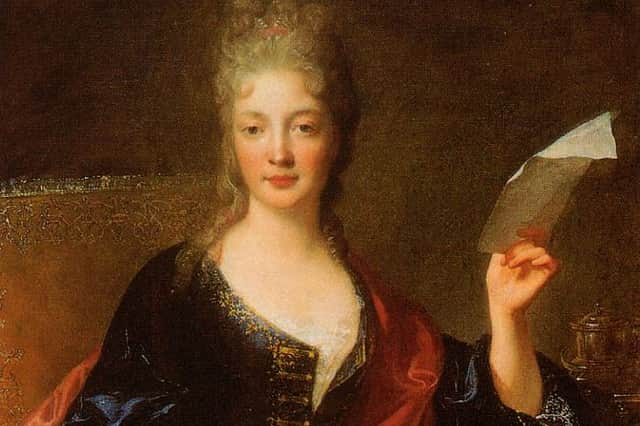
When I first encountered them, I was surprised by how unsentimental they are. These are not goody-two-shoes, moral fables in which everything is neatly resolved. Instead, they feel full of hesitation, contradiction, and unease. Her characters are often trying to make sense of a system - be it divine, political, or social - that seems arbitrary, or at the very least ineffable. Her music shifts quickly, changing direction swiftly, working things out.
Translating them into English and ensuring they resonate today, I found myself leaning into the uncertainty. My job wasn’t to tidy the stories up, or to inject relevance, but to open them out: to allow their edges to feel raw and present. We tend to think of early music as something polished, even serene: an artform sealed behind glass. But working on this piece with director Jennifer Fletcher and the team at Mahogany Opera, Dunedin Consort and Hera, what has struck me is how much volatility there is just beneath the surface.
Take Adam. In this version, the story of the Fall is told without Eve. The ending stays the same, but there’s something unsettling, even disorienting, in the telling. Without a scapegoat to blame – there’s no serpent here either – there’s just a Father whose love feels a lot like a test, and a man making a decision that carries dizzying consequences. In embracing appetite, he finds freedom and self-knowledge, but also lasting shame and uncertainty.
Or Jonah. His story is often told as one of redemption: he runs away, is swallowed by a whale, and eventually does the right thing. But if you stay inside the moment, as the music asks us to, it feels quite different. The sea becomes overwhelming, the people around him turn quickly to self-preservation, and the whale itself begins to seem less like punishment and more like refuge. A place to hide. A place to pause. I keep coming back to this image - being inside something enormous and unknowable, and finding, for a moment, a strange kind of safety there – as a way to think about art and music.

The third story, Jephthah, may be the most unsettling of all. It begins in celebration, with two angelic-sounding voices singing together in joy, as a military victory brings the promise of safety and security. And then it turns, almost imperceptibly, towards something else. There is a terrible price that must be paid. Suddenly the story opens out into a grief that is too large for the stage to contain.
These are ancient narratives, and yet they don’t feel distant. If anything, they seem to echo more loudly than ever. Questions about power - who has it, how it is exercised, what it demands in return - run through all three pieces that make up In the Belly of the Beast.
That doesn’t mean we’re offering answers. How could we? In making a new English version, I have tried instead to let the ambiguities remain. As well as emotion, the text has moments of plain speaking and wit. Sometimes there is a sort of ironic, gallows humour. Sometimes there is heartbreak. Worlds are conjured in a handful of words, yet elsewhere a single moment stretches out to swallow us. These qualities are present in the original text by Antoine Houdar de la Motte, but they can sometimes be smoothed away in more formal, better-behaved translation.

Just as important, for me, is the way the piece is staged: the creative team have created a stage environment which is rich and strange, to hold the audience’s encounter with the stories. This isn’t a concert performance. The singers move through a space shaped by light and shadow; the scale shifts quickly, from something almost private to something vast and unstable. And yet the heart of it remains very simple: two voices, a small group of instruments, and a story being told directly to the audience.
For those who don’t regularly go to early music or opera, I think that simplicity might be unexpected. There is no need to know the stories in advance, or to have a background in the genre. If anything, it can be more interesting to come to it fresh and to let the music and the words unfold as they are, without the weight of expectation.
I’ve always felt that these pieces reward listening in a particular way: not as something to be admired from a distance, but as something to sit inside. Much like Jonah in the whale, perhaps not entirely comfortable, but strangely held. For a form that is often associated with precision and control, they feel like an important reminder: that the past was never as orderly as we imagine it to be. And that, across 300 years and more, the emotional life of these stories is still very much alive.
In the Belly of the Beast is at Assembly Roxy, Edinburgh, 19 June, Perth Theatre, 2 July and Stevenson Hall, Glasgow, 3 July, see www.wearehera.uk/in-the-belly-of-the-beast
The Scotsman’s arts newsletter is now sent twice a week - subscribe today
Want the latest Scottish headlines sent directly to your phone? Sign up to our new WhatsApp channel here
Comments
Want to join the conversation? Please or to comment on this article.