
Celtic Connections reviews: Our Mother Tongue | The Conundrum
These two Celtic Connection concerts highlighted the resilience of ‘minority’ languages in song and the rich diversity of piping, writes Jim Gilchrist
The Conundrum: International Piping Concert, City Halls, Glasgow ★★★★
Not so much a Tower of Babel as a colloquy of so-called “minority” languages, Our Mother Tongue found them to be demonstrably alive and kicking in music and song.
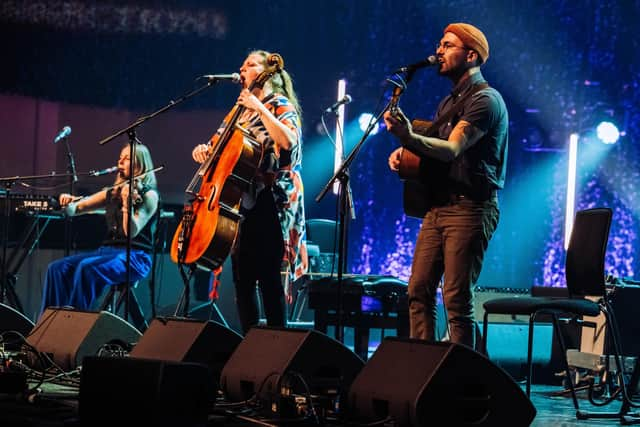

A hefty Québécois presence included a sparkling opening set from Montreal-based trio ÉTÉ, their fiddle, cello and bouzouki –based instrumentals bolstered by foot percussion and a snappy step dance break-out from their fiddler, Élisabeth Moquin. The sole Scottish Gaelic contribution followed, from the concert’s MC, Mischa Macpherson, whose delicately poised song, composed by an exiled Islay bard, reflected the clearances that forced many a Gael to Glasgow.
Another French-Canadian band, Paruline, brought a heavier, indie-folk-rock sound with echoing guitars and drums and some powerful vocal harmonies, although, arguably, the two strikingly distinctive voices came from Welsh and Irish Gaelic cultures. Firstly came the Gwilym Bowen Rhys Trio, featuring the growly lyricism of Rhys’s singing cusped in fiddle and harp, including a 16th century condemnation of tree-destroyers. From Ireland, meanwhile, bilingual singer-songwriter Padraig Jack evoked his native Aran Island shore, pummelled by the Atlantic, in Making Sand.
There was an intriguing cultural melting pot – instrumental rather than linguistic – in the Northern-Irish-Iraqi septet Macalla with harp, fiddle and whistle sounding alongside Middle Eastern zither and Arabic oud in that hoary old O'Carolan tune Sí Beag Sí Mór while a jig danced its way from west to east.
Super Furry Animals frontman Gruff Rhys, a champion of Welsh language in pop, appeared solo, against a backdrop of birdsong and including the bemusing Iolo with its ululating refrain – although with little explanation of what the songs were about. Then it was back to Quebec for a high-energy finale with Le Vent Du Nord (making their 22nd Celtic Connections appearance), a whirl of fiddles, hurdy-gurdy and jawharp and of course those bionic percussive feet, carrying songs, often in zesty call-and-response.
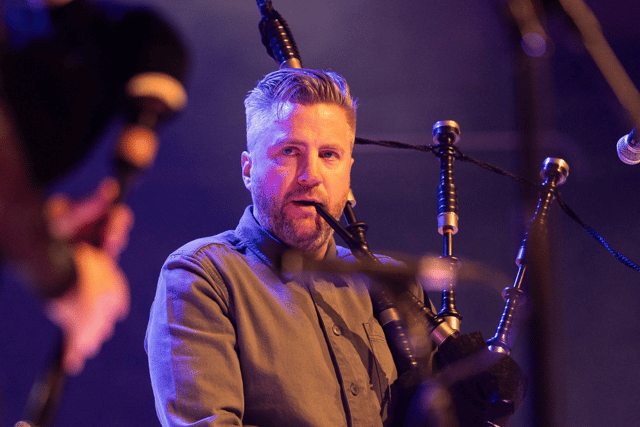
Any suspicions as to where that distinctive throwing to and fro of refrains might have migrated from was confirmed by the imposing presence of the Breton pipe band Bagad Cap Caval, of whom more later, during the festival’s annual piping night, The Conundrum. Drawing on a rich convergence of piping cultures, it opened with the syncopated bubbling of Scottish smallpipes, handled with unhurried virtuosity by Brighde Chaimbeul, dwelling on a keening air that shifted into easeful jig time. She was followed by the first Breton presence of the evening, flautist Jean-Michel Veillon who played a quavering lament before slipping with guitarist Nicolas Quémener into a distinctively stepping Breton dance tune and a trio of Irish hornpipes.
Further Irishry came in the form of the twin uilleann pipes of Michael McGoldrick and John McSherry, playing tightly together despite the complex “plumbing” of these most sophisticated of bagpipes, and bringing freshness to a set which, we were informed, they first recorded together some 25 years ago. The duet approach continued with Highland pipers Finlay MacDonald (the evening’s MC) and Ailis Sutherland, the pair switching between breathy flute and whistle and intense, full-force twin Highland pipes, over a beaty accompaniment from the house accompanists, guitarist Ali Hutton and drummer Paul Jennings.
From north-west Spain’s piping-rich Galicia came a solo set from Nadia Vazquez, shrill torrents and flurries of notes cascading dazzlingly from her gaita, the bagpipe of the region. Then things steered towards a spectacular finish as the red-T-shirted pipers of the championship-winning Bagad Cap Caval filed on stage, the unmistakeable kan ha diskan – call and response – between their Highland pipes and bombardes, the strident Breton oboes, escorted by a crisp Celtic Connections drum corps.
Their repertoire included distinctively circling Breton dance tunes and the wistful yet anthemic song air Kimiad. As an irrefutable statement of reed and drum power, it took some beating.
The Scotsman’s arts newsletter is now sent twice a week - subscribe today
Want the latest Scottish headlines sent directly to your phone? Sign up to our new WhatsApp channel here.
Comments
Want to join the conversation? Please or to comment on this article.