
Inside the national Moving Image Archive where silent movie festival Hippfest sources its material

More than 50,000 clips which tell the stories of Scotland, its people and places are held in the archive
Since the fire on Glasgow’s Union Street last weekend, the national Moving Image Archive in the city’s Kelvin Hall has been inundated with people looking for historic images of the now-ravaged building.
“We’ve had a lot of people walk in and just ask ‘have you got footage of the building as it was?’,” says learning and outreach officer Sheena MacDougall. “It isn’t news organisations or officials, just people who are here using the gym or passing by, they want to see it as it was.”
The archive, which is celebrating its 50th anniversary this year, started off as a job creation scheme masterminded by the Scottish Film Council in 1976 before being incorporated into the National Library of Scotland.
It holds more than 50,000 items of Scottish film and video sourced and donated over the years from private attics and garages, film clubs, councils, businesses and local museums.
Incorporating a cross section of Scottish filmmaking spanning 130 years to the present day, the oldest item in the archive is an 1896 piece of footage of Queen Victoria at Balmoral, verified through her own detailed diaries. The film is considered to be extremely rare, dated just 10 months after the Lumiere brothers premiered the first motion picture film in Paris.
However, the vast majority of the footage is amateur, with much of it coming from the once-thriving Scottish amateur filmmaking community.
“The word amateur is misleading because they really weren’t amateur at all,” says Ms MacDougall. “They really were amazing filmmakers that did fantastic, innovative work.
“It’s where you find the passion. It’s the same way that today you have people who want to create content using new technology. Back then, people were creating films because they loved it. It was new and it was different and Scotland was a complete leader in the world of film, especially with Films of Scotland.”
Films of Scotland, started in 1938 by pioneering Scottish filmmaker John Grierson for the Empire Exhibition in Glasgow, was a series of documentaries which aimed to showcase Scotland to the world. It ran until 1982.
The archive is also a major resource for HippFest, Scotland’s only silent movie festival, which trawls its archives for often forgotten amateur footage to make up its New Found Sound strand, where silent films are accompanied by music performed live by Falkirk young musicians.

With sound a relatively new technology in filmmaking, especially at the amateur level, the vast majority of footage in the archive is without sound.
HippFest’s screenings often unearth material which has not been shown in decades, some of which was highly acclaimed in the filmmaking community at the time.
This year’s New Found Sound strand, which is curated by school pupils from the Falkirk area, includes Witch Craft, a piece from Edinburgh filmmaker Jean L Gray, a rare female presence in the male-dominated amateur film world of her time, which uses textured glass, ink in water and animated figures to create surreal visual poetry.
The film will be accompanied by original music scored by local music pupils at this year’s HippFest, which runs from 18 to 22 March.

The festival, held at Scotland’s oldest purpose-built cinema in Bo’ness, will also show two other pieces of amateur Scottish footage from the archive, including Evening Sail, a comedy about a man taking his boat out on the west coast.
"The National Library's Moving Image Archive is an invaluable keeper of Scottish history from 1896 to the present,” says HippFest director Alison Strauss. “Preserving and making available our film heritage that encompasses all aspects of life in Scotland for more than a century.”
In the archive room, acquisitions curator Kay Foubister shows me a programme from the British Empire Amateur Film Festival from 1938, which was held in Glasgow and incorporated the fifth Scottish Amateur Film Festival. As well as films, the archive also holds a large amount of paper material relating to filmmaking, including programmes, letters and posters.
Witch Craft is included in the nominations, alongside other Scottish-made gems such as A Journey Through Palestine, by Fred Nettler from Glasgow and The Vase, by the Ayr Film Unit.
The main adjudicator is listed in the programme as none other than Mr Alfred Hitchcock.
“When the Scottish Amateur Film Festival began, big directors would come up and adjudicate and make the awards for the amateur films,” says Ms Foubister. “That included Alfred Hitchcock and [The Red Shoes director] Michael Powell. Hitchcock even donated a trophy.

“This ran until the late 1970s and became an international thing. At that time, students from UCLA would distribute their student films to various film festivals [including the SAFF]. Robert Zemeckis won in the early 1970s for his amateur film. And then 10 years later, he was making Back to the Future.”
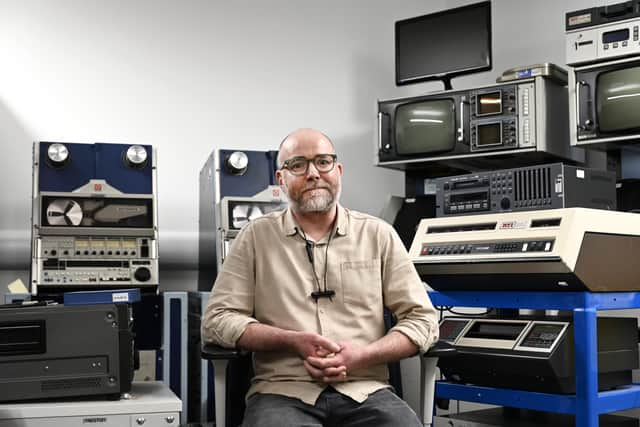
The archive’s video room holds a wide range of antiquated film equipment from VHS machines to Betamax. Any new addition to the archive has to be digitised before it is analysed by experts.
“We digitise everything first to minimise the number of times it has to go through a machine,” explains senior preservation technician Stuart Wilson.
A project to digitise everything in the centre’s archive was completed last year. But time is ticking for any new acquisitions.
“In a couple of years, we might not be able to do any of this any more,” says Mr Wilson.
Most of the equipment is original, dating back decades. However, it is becoming obsolete, with most devices no longer in production, while people with expertise in repairing old video machines are now a rarity.
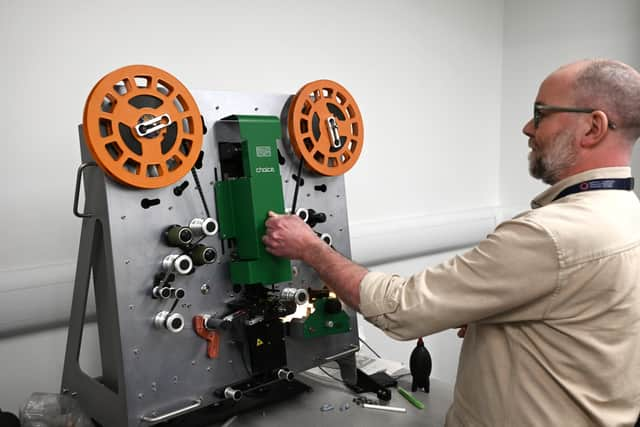
“We had one guy who did our repairs, but even he has now retired fully,” he adds.
One exception to the museum-style feel to the room is a single, modern computer in the corner.
“That’s where we download all digital footage,” explains Mr Wilson. “That’s a lot easier.”
Comments
Want to join the conversation? Please or to comment on this article.