
The best films of 2025: Alistair Harkness picks his highlights
From Scott Cooper’s take on Springsteen to an animation about a cat trying to survive a flood, Alistair Harkness names his top ten films of the year
One Battle After Another (15) Paul Thomas Anderson raises the filmmaking bar with One Battle After Another, a blistering cinematic coup d’état against the atrophied ambitions of most big budget filmmaking. Capitalising on Leonardo DiCaprio’s box-office cache, he’s taken slippery source material – Thomas Pynchon’s freewheeling 1990 novel Vineland – and transformed it, thrillingly, into a wild ride through America’s radically divided political landscape, not with hectoring polemics, but with an exhilarating, brilliantly directed story shot through bank robberies, immigration raids, white supremacist cabals, gun-toting nuns, one beer-guzzling karate sensei (played by Benicio Del Toro), and an audacious climactic car chase that manages to thoroughly re-invent this over-used action movie staple.


The Brutalist (15) There’s something of Paul Thomas Anderson’s There Will Be Blood in The Brutalist, in the way director Brady Corbet uses the twisted, masochistic relationship that his main character László Tóth (Adrien Brody), a Hungarian Jewish architect, forms with another man as a prism through which to explore ideas about America. That man is Harrison Lee Van Buren (Guy Pearce), a Philadelphian tycoon whose library László has been hired to renovate. Their first meeting does not go well, but Van Buren gradually comes to learn that László, a survivor of the Buchenwald concentration camp, was formerly an architect of some renown, a Bauhaus-trained artist in whose artistic glory Van Buren now wants to bask. Commissioning him to build a grand institute on top of a nearby hill, Van Buren’s patrician-style benevolence masks some deep-rooted prejudices that gradually come to the fore as László’s singular vision and obsessive attention to detail make the build a more complex and expensive process than anticipated.
READ MORE: Avatar: Fire and Ash review: 'tedious'
A Real Pain (15) Tightly written, directed and performed, actor-turned-filmmaker Jesse Eisenberg’s sophomore feature, A Real Pain, explores the residual horror of the Holocaust for subsequent generations via a witty and wise road movie following two cousins making a pilgrimage to Poland to visit the childhood home of their recently deceased grandmother (a Holocaust survivor). Played by Eisenberg and Kieran Culkin, said cousins are an odd pair: once closer than brothers, they’ve drifted apart in recent years, with Eisenberg’s David now a nervy bundle of medicated neuroses whose boring internet job, loving wife and adorable toddler son leave him little time to hang out with Culkin’s Benji, a directionless but charismatic slacker whose ability to say whatever he wants is both energising and infuriating.
Flow (U) Flow was this year’s deserved winner of the Oscar for best animated feature. Made by Latvian filmmaker Gints Zilbalodis using open source software, it’s a wondrous tale of a cat attempting to survive a biblical-style flood by teaming up with various other animals – including a Labrador, a capybara and a lemur – and embarking on a picaresque adventure that takes in ancient ruins and giant sea creatures. Eschewing dialogue and any hint of anthropomorphism, the film’s painterly, DIY approach is thoroughly enchanting, liable to hold audiences rapt if they’re six or 60.
Weapons (18) Weapons finds writer/director Zach Cregger following up his outré debut Barbarian with a horror film that subverts expectations on an even grander scale. It’s built around a creepy premise: one night, all but one of the kids in the class of a new primary school teacher mysteriously disappear, leaving the town in shock, the parents angry and the teacher, Justine (played by Julia Garner), the focus of everyone’s suspicions and confusion. Intriguingly, though, Cregger doesn’t then turn it into an anguished missing children movie. Instead, starting with Justine, he decides to zero in on a handful of characters, incrementally exploring the mystery from overlapping perspectives and immediately wrong-footing those looking for a straight-up supernatural chiller.

Springsteen: Deliver Me From Nowhere (12A) Charting a transitional phase in Bruce Springsteen’s career when he retreated from the breakthrough success of 1980’s The River to record Nebraska instead of what would later become Born in the USA, Springsteen: Deliver Me From Nowhere is that rare thing: a mainstream biopic of a proper rock legend that feels in sync with its subject. Starring The Bear’s Jeremy Allen White as the Boss and written and directed by Crazy Heart’s Scott Cooper, it’s a film that works like a good Springsteen song by embracing and interrogating American myths and archetypes to reveal something more truthful about the people struggling to live up to them, in this case Springsteen himself.

A House of Dynamite (15) A white-knuckle political procedural about an imminent nuclear strike on American soil, Kathryn Bigelow’s A House of Dynamite sees the Hurt Locker director zero in on the terrifying reality of a world in which mutually assured destruction is no longer the deterrent it used to be. Taking a Rashomon-like approach to impending catastrophe by counting down the same 20-minutes-until-impact time-frame from different perspectives, the film kicks off by focussing on the soldiers manning an Alaskan missile defence outpost, before moving up the chain of command to various White House analysts, senior-level government officials, Pentagon generals and the president himself (Idris Elba) as the realisation dawns on everyone that the unidentified blip on their radar screens is no training exercise.
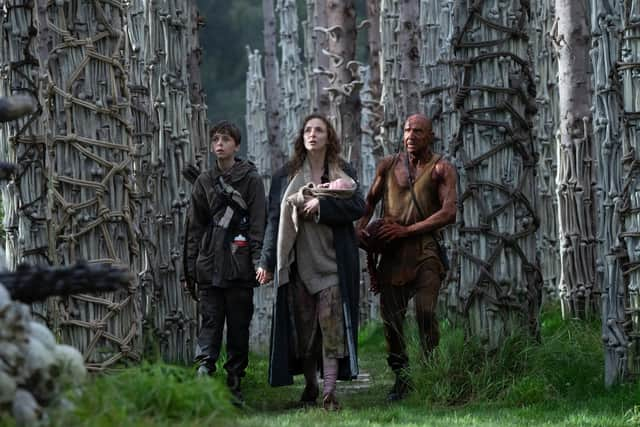
28 Years Later (15) Post-Brexit, post-Covid, and with the political landscape increasingly hostile, it’s hardly surprising director Danny Boyle, writer Alex Garland and producer Andrew Macdonald have chosen to revisit the 28 Days Later zombie franchise with 28 Years Later, an almost real-time sequel that follows on from the first film and its 2007 follow-up 28 Weeks Later. A short bit of expository text informs us that Europe was successful in pushing the Rage-infected zombie hoards back and Britain has been quarantined ever since, its coastlines patrolled by the navies of Europe, its surviving population left to fend for themselves. We see all this through the eyes of the film’s 12-year-old protagonist Spike (Alfie Williams), who starts to see through his dad’s hunter-gatherer bravado (his dad is played by Aaron Taylor-Johnson) while on a rites-of-passage excursion to the mainland to get his first zombie kill.
The Phoenician Scheme (15) In Wes Anderson’s The Phoenician Scheme, Benicio Del Toro plays Zsa-Zsa Korda, a business tycoon in crisis who enlists his convent-bound daughter Leisl (Mia Threapleton) in a quest to pull off a complicated business deal after a series of failed assassination attempts force him to confront his own mortality. The resulting film moves at a fair clip as Anderson crams in arch gags, surreal action sequences and his usual array of kooks and crazies, none of which is likely to convert Anderson agnostics, but if you’re already on board, it’s another intriguing piece of the meticulously designed puzzle that is his work. And Del Toro really is magnificent.

Dragonfly (15) Paul Andrew Williams’ unsettling new drama charts a tentative friendship between a lonely pensioner and her guarded next-door neighbour after a fall leaves the former reliant on carers. Respectively played by Brenda Bleythn and Andrea Riseborough, each actor brings the full force of her talents to bear on the film – Bleythn embodying the indignity of ageing with unflinching candour as her character, Elsie, endures a series of on-the-clock carers who don’t always know her name, and Riseborough infusing the hostile-on-the-surface Colleen with an empathy denied her by the world at large. It’s a powerful film, unnerving and heartbreaking in equal measure.
The Scotsman’s arts newsletter is now sent twice a week - subscribe today
Want the latest Scottish headlines sent directly to your phone? Sign up to our new WhatsApp channel here.
Comments
Want to join the conversation? Please or to comment on this article.