
Fringe theatre reviews: Supposing | For Dolores | Badgers
Joyce McMillan observes a remarkable collision between the everyday and the elemental, a smart and vivid character study, and a whip-smart Irish play set in Scotland.



Supposing ★★★★★
For Dolores ★★★★
Badgers ★★★★
All Traverse Theatre (Venue 15) until 30 August
If the Western world is currently living through the strangest of moments - a bizarre mix of the apocalyptic, the self-absorbed, and the frantically busy everyday - then no poet or theatre-maker captures that crisis, and its impact on women, more vividly than the brave and remarkable Zinnie Harris.
Her latest play, Supposing, is an outwardly simple two-hander, placed on an empty stage with a few pieces of domestic furniture easily pushed back into the dark; and it tells the tale of its central character, Sally, through a mixture of monologue, and fraught conversations with her husband, Richard.
Sally is a middle-class wife, mother and manager in her forties who one day falls into a hole in the street outside the local theatre, and emerges a changed woman. She is haunted by visions, premonitions, and a need to give warnings to those affected, particularly her bigoted racist neighbour, and a young woman violinist living in one of the town’s refugee hotels; she also feels herself accompanied, since the fall, by a 17 strong female Greek chorus, who constantly comment on her actions.
Enjoying The Scotsman's coverage of the Edinburgh festivals? For just £2 a month you can get unlimited access to scotsman.com plus 2-for-1 Fringe tickets. For details visit www.scotsman.com/subscriptions
What has happened, it seems, is that in this strange moment - with its rising tides of fascist rage, and its growing liberal despair - Sally’s everyday, fact-based modern life has abruptly collided with the dark and elemental forces of ancient Greek drama that Zinnie Harris has often explored so brilliantly in her writing; and in no time, this new, raging Sally finds herself becoming a mix of the prophetess Cassandra and the blind seer Tiresias, her eyes blurring, her house plagued by frogs, her chorus morphing into Furies, her mind full of tragic or apocalyptic visions.
That this collision between the everyday and the elemental has its comic aspects is obvious; and they are beautifully and delicately captured by both Nicole Cooper as Sally, and Richard Conlon as Richard, desperately struggling to understand what has happened to his wife, and to explain and medicalise the situation away. There is no actress better equipped than Cooper, though, to capture in her stunning performance the astonishing emotional and physical journey into the underworld that Sally increasingly undergoes, leaving Richard helpless in her wake.
The poetry of Harris’s writing gleams and hallucinates ever more brilliantly as the play unfolds, while every aspect of her own production comes together to support it. And when two new presences appear on stage, towards the end, it seems like a sign that the new world in which Sally now lives is full not only of horrors, but also of unexpected moments of beauty, as surprising as they are wonderful.
Malaika Kegode’s Badgers also implies a warning not to anger the old gods; although here, the gods are the old English spirits of the greenwood, field and stream.
In the show, Kegode plays a young Gen Z woman, an unsuccessful podcaster who has returned to her old hometown to nurse her award-winning journalist mother through a painful terminal illness; and when she hears the story of a young musician who disappeared from the town a decade before, while staying in an Air BnB owned by local folk singer and tradition-bearer Bridget Brock, she is quick to lie her way into Bridget’s kitchen and confidence, and to start recording, with or without permission.
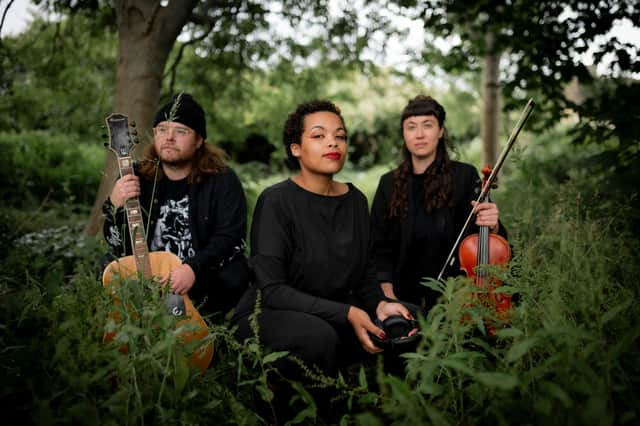
Badgers is a show that suffers slightly from its attempt to do too many things in a brief 75 minutes. Apart from Kegode and her two brilliant musicians, it boasts a slightly cluttered stage, a fair number of technical bells and whistles, and a cluster of narratives - Meles’s low self-esteem and dodgy 21st century career, her mother’s illness and death, the audience supposedly playing Meles in the show, and above all Meles’s encounter with Bridget and her wisdom - that never quite blend together as they should.
The result is a show that features far too many endings, including one perfect one, about five minutes before the actual end; but is nonetheless far too smart, vivid and searching to ignore, in its quest to identify the emptiness at the heart of Meles’s life, and to begin to suggest what it is that she, and millions of others, might be missing.
Eva O’Connor’s For Dolores, meanwhile - produced by the legendary Irish company Fishamble - offers a much tighter focus on 21st century private lives; but is a brilliantly vivid piece of writing nonetheless, superbly performed by Lara McDonnell and Catriona Faint as best friends Realtin and Mo, who meet in a broken-down lift at Pollock Halls on their first day at Edinburgh University.
For Dolores is that rarest of things, an Irish play almost entirely set in Scotland; and if there is punishment by the gods going on here, it must be for the mismatch at the heart of Mo and Realtin’s relationship from the outset.

Mo is a brilliant young gay woman, a working-class Glaswegian studying radical politics; and for her, it is love at first sight with Realtin, who is happy to embrace Mo as best friend and soulmate, but still loves her men. It’s a contradiction that leads to utter disaster soon after the two graduate, as Realtin contracts a bizarre engagement to a wealthy Finn, only to get pregnant by another man during her own engagement party, with consequences both absurd and utterly tragic.
The play takes the form of flashback memories recounted by the friends two years later, when they are undergoing counselling after a hellish year of trying to live together and bring up Realtin’s feisty baby daughter, Dolores. And like all the best Irish writing, it has that fabulous quality of conjuring up images and narratives as vivid as the best of movies, while remaining completely alive; in a whip-smart production by Jim Culleton that brings the audience to their feet in roars of appreciation, as the story reaches its sharp and perfect ending. Joyce McMillan
The Scotsman’s arts newsletter is now sent twice a week - subscribe today
Enjoying the Arts & Culture journalism on scotsman.com? Make it easier to find by selecting us as a preferred Google source
Want the latest Scottish headlines sent directly to your phone? Sign up to our new WhatsApp channel here
Comments
Want to join the conversation? Please or to comment on this article.