
EIF music reviews: Wroclaw Baroque Ensemble | Østerlide | Up Late: Jazz Jam + more
Our latest batch of music reviews from the EIF includes a concert of wonder, joy and even hope, a powerfully experimental Norwegian folk trio, and a tactile combination of electronic music and arthouse video.
Wroclaw Baroque Ensemble ★★★★★
Queen's Hall
The sound that this remarkable ensemble achieves in very old music is entirely new and startling.
In Zebrowski´s Offertorium, from the early 17th century and as ancient as Poland can remember such things, trombones clucked along with a clarsach-like harp, voices declaimed Allelujahs, a violin played a plain line with the voice above decorating in fantastical detail over a deep bass.
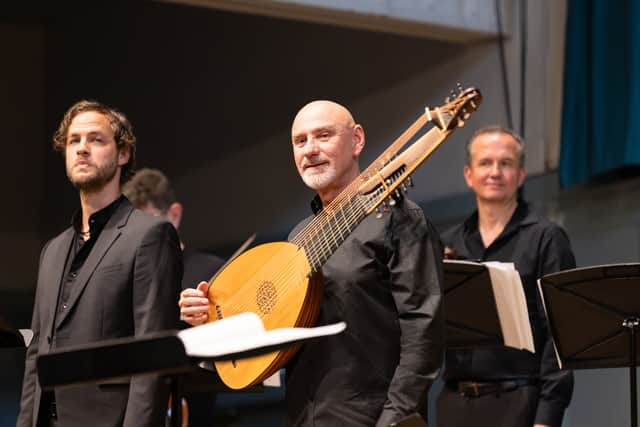

The musicians play and sing as though the music is written on fragile glass, eliciting emotions as clamorous as a vast symphony.
We skipped two centuries adding two trumpets to Zebrowski´s Vesperae for Maria Virgine opening with a jaunty Dixit Dominus. Three bold male voices announced each section in excited unison, two violins climbed in extraordinary obligati – we were to hear more fantastical duets – and voices became more operatic as psalms and antiphoni wound round our ears.
Clearly, we learned that this European enclave of liturgical greatness delivers a distinctive, highly personal sound far removed from English flutey refinement. Singers, players sang out in smiling exultation, rode on leaping lines and drew the audience in as though we were entitled, right now today, to celebrate a shared liturgical history of miraculous benedictions and heady prayers.
A concert of wonder, inspiring joy. Hope, even.
Mary Miller
Østerlide ★★★★
The Hub
Of all the diverse range of instruments employed by Norwegian contemporary folk trio Østerlide during their Saturday night set at the Hub, the most intoxicating was singer Liv Ulvik’s voice, a transporting sound which fits comfortably into the cracks between genres.
It contains a reedy folk tone, the haunting precision of a choral soloist and the high, controlled volume of an opera singer.
Alongside this powerful focal point, guitarist and group founder Andreas Haddeland and drummer and percussionist Ulrik Ibsen Thorsrud built a bed of sound rooted in Norwegian folk traditions, but with a richly alternative, experimental edge.
Their songs are rooted in medieval Norwegian balladry and folklore, and with all the lyrics being in Norwegian, Ulvik was fortunately on hand for background and context.
Sometimes this meant as little as explaining that one song from northern Norway is about a fishing trip which caught “a very large halibut”. Elsewhere – for example Nykkjen’s tale of the mythical Norse creature the Nykk, like a male mermaid, coming ashore and snaring a young woman by pretending to be a powerful knight – this meant short storytelling excursions between songs, enjoyable in their own right and bringing resonant cultural context.
This last song was also possibly the finest example of how out-there the trio’s sound can be, with Thorsrud creating a powerful, storm-like cacophony by scraping the edge of a cymbal across the skin of his drum while Haddeland’s electric guitar wailed.
Inga Litimor (a Norwegian medieval ballad, says Ulvik, where “nothing scary happens, no-one dies… this is very unusual”) is built on a tense, insistent acoustic rhythm, while Haddeland’s guitar sounded positively swampy on Riddaren.
The Norwegian tradition doesn’t often demonstrate “big feelings”, explained Ulvik before the closing Farvel min venn (Goodbye My Friend); it tells dramatic stories, but in a down-to-earth way.
“This song has big feelings,” she laughed. “It makes us almost embarrassed.”
Its fusion of slow Portuguese fado with their own sound, set to Thorsrud’s whistling bowed saw, was epic in a different way.
David Pollock
Up Late: Jazz Jam ★★★★
The Hub
Late-night, perhaps, but not too intensive, this jam session was the culmination of celebrated pianist Joe Webb’s festival mentoring of four aspiring young jazz players, alto saxophonist Rosalind Orr, trumpeter Liam O’Neil, double-bassist Tim Allan and drummer Chun-Wei Kang.
A programme of much loved jazz classics, it kicked off with the ebullient swagger of Blues Walk. Another old favourite was I’ve Found Another Baby, Webb taking it away with characteristic brilliance, supported by Allan and Kang.
Orr took a lengthy, easeful sax break during Thelonious Monk’s Let’s Cool One, O’Neil also sounding out confidently, and they followed that with a ballad sequence, ending with the lazy strut of Ellington’s Isfahan, while Webb and Allan duetted deftly in Ellington’s Pitter Panther Patter.
They were joined latterly by two familiar Scottish jazz names – bassist Mario Caribé and trombonist Chris Greive – and also, briefly, by the young Ony Marsalis, who gave dreamily languorous voice to the Gilberto-Getz number Corcovado.
Greive added gutsy trombone heft to numbers such as Stompin’ at the Savoy (Chun cutting loose on drums). It was a pleasure to hear these classics reprised with creative energy and regard by this emerging young talent alongside seasoned masters.
Jim Gilchrist
Up Late with Kaitlyn Aurelia Smith ★★★★
The Hub
At the very end of a heaving, packed festival day on Castlehill, fans of Edinburgh International Festival’s contemporary music strand were reminded of former director Fergus Linehan’s adventurous programming in this category.
Anyone hoping to hear a young classical soloist on the Hub stage would likely have been nonplussed, as Los Angeles-based electronic composer Kaitlyn Aurelia Smith instead appeared behind a simple trestle table set-up, with an array of devices and synthesisers before her.
Her music was a wash of satisfyingly heavy basslines and smooth, liquid rhythms, and she sang vocals into her headset mic. Her voice sounds naturally sweetly-toned, but with this channel electronically processed to add poppy artificiality and her vowels largely elongated for extra musicality, it reminded here of Grimes or the Knife’s Karin Dreijer.
While Smith performed, an odd collection of homemade arthouse videos played on the screen above her, from the ASMR fruit-squeezing accompanying Feel Heard, to weird experimental physical theatre pieces like Smith and another young woman clambering in slow motion across a coffee table during Urges, to her peeling fruit from under a coffee table during Gush.
These works felt like secondary accompaniments to the music, but in places they worked very well, with what looked like caramel melting in a pan echoing Around You’s wobbly, warm, unsettling beat and dynamic POV clips of Smith racing across the desert by bike.
Between these clips and the core-shaking bass, it felt an oddly tactile set.
David Pollock
LSO: Puccini's Suor Angelica ★★★★
Usher Hall
With Puccini and Pappano, we were deep into territory he has made his own. Restraint, polish and the fluent tempi that he and his orchestra perfect, all was set here for the kind of emotional reactions which swerve from the glorious to red-rimmed eyes.
Novelties first: Puccini´s graduation piece with its youthful rehearsal of the themes which would dominate La Boheme to come. Then Trieste-born de Sabata´s explosive Juventus. Succeeding Toscanini in Milan and allegedly a terror on the rostrum, his music is tremendous, rattling with staccato, rowdy brass and Disney-like sweep.
Suor Angelica, tragic, super-sentimental and musically stunning, is not a concert hall piece. While beautifully cast here with glamorous nuns, a superb Angelica (Carolina Lopes Morano) and a Principessa (Ksnila Nikolaieva) of dragon-like appearance and gestures, whose contralto blasted flames, a sense of shocking theatre was hard to achieve other than in the most devastating scenes.
The chorus, singing bravely, seemed to produce distant commentary rather than to produce the cluttered, fevered atmosphere the opera demands.
But Puccini´s operas always strike deep. His understanding of theatre, of how musical tension can only arise from calm is flawless. Never abandoning 19th century operatic roots, approaching impressionism colours his late work. The exultant audience roared in approval.
Mary Miller
Rising Stars: Strings’ Classical Jam ★★★
The Hub
As director Nicola Benedetti pointed out in her introduction, musicians do love to play, and not just on the platform. Imagine soloists huddled in a hotel bar heady with the ring of the night´s applause, shouting ‘Yes! Let´s play some more Brahms…’
So, she had gathered the excellent young international players from EIF´s commendable mentoring programme to swap groupings spontaneously and to dig into a raft of music. We, the audience, were free to interject ideas.
The problem was that we were just that: audience in a hall, not casual eavesdroppers on a party. It felt as though we were ringside, invited to meet a group of friendly tigers and asked to feed them by hand without fear. The playing, though, was terrific in repertoire, full of favourites all presented with delight, passion and extraordinary skill.
There were moments of chaos as chairs and music stands swivelled, some outbursts of endearing shyness; the bonhomie between the musicians was touching, and for sure, the future of brilliant musical standards is in safe hands.
In the end, everyone wanted Tchaikovsky. Instead of his Souvenir de Florence as sextet we heard a fourteen-tet, everyone crowded onstage playing gloriously, hearts and souls, bows and strings flying.
Not a jam, but a great friendly concert conceived with the best intentions and with the finest of fiddlers.
Mary Miller
Make sure you keep up to date with Arts and Culture news from across Scotland by signing up to our free newsletter here.
Comments
Want to join the conversation? Please or to comment on this article.