
EIF music reviews: Mark and Maggie O’Connor | Brass Fanfare | The Shining Night | Venice Baroque Orchestra
From an Appalachian Waltz to a symphony inspired by Fife, this year’s Edinburgh International Festival music strand ranges far and wide


Mark & Maggie O’Connor, The Hub ★★★★★
They kicked off with their twin fiddles birling out a reel, Mark traipsing about the octaves over Maggie’s keen spiccato chops. They make quite a duo – Mark a former youthful prodigy on bluegrass fiddle who has gone on to collect multiple Grammies and whose playing (also on guitar and mandolin) gleefully defies genres, while Maggie is a conservatoire-schooled violinist with a family background in bluegrass.
As a duo, they radiate musical empathy, not least in their twin fiddle approach, as in the swooping, sliding harmonies of his much-loved Appalachia Waltz, while Mark’s solo fiddle trilled and darted in a movement from one of his concerti.
He also demonstrated his mastery of mandolin, particularly in an old Dolly Parton song, Wildflowers, with Maggie’s singing infused with country warmth evident in other songs such as Ride Towards Home, her tribute to the horse’s contribution to humanity,
Butterfly’s Day Out saw mandolin ring out against fiddle, and Mark also showcased his formidable guitar flatpicking when he tuned the instrument to a drop C, for a furiously ringing and churning excursion. It was back to twin fiddles, however, to close with a Tiger Rag that left us with our heads full of zinging strings. Jim Gilchrist
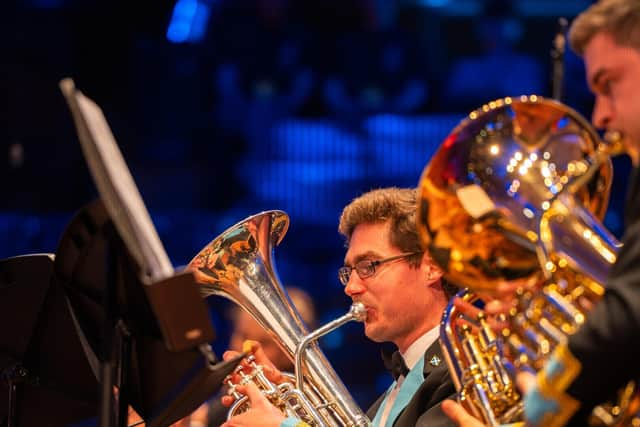
Brass Fanfare: A Tribute To John Wallace, Usher Hall ★★★★★
A world-class trumpeter, born in Fife, as well as a stormtrooping music educator, John Wallace’s influence was felt even before this concert began. Outside, an ensemble of talented brass players from the Junior Department of the Royal Conservatoire of Scotland – where Wallace was a ground-breaking principal – provided a warm welcome.
In introduction, EIF director Nicola Benedetti spoke on behalf of everyone whose lives had been touched by Wallace, conveying the deep affection and universal respect in which he was held.
With members of trophy-winning The Cooperation Band alongside professional players from Scotland’s national orchestras, The Wallace Collection and the young musicians of StAMP (St Andrews Music Participation), a project initiated by Wallace, first up was the declamatory Sonata No 336 by Italian Baroque trumpeter Bendinelli.
Moving onto Wallace’s own composition, Symphony, scenes of life in Fife, its history and traditions brought new dimensions, with its complex scoring.
Elgar Howarth’s brilliant arrangement of Pictures At An Exhibition never fails to disappoint, and so it was here with the SCO, RSNO, BBC SSO, Wallace Collection players and conductor Clark Rundell.
To close, Lament, Hope & Stomp was a riot of sound and colour, with massed brass and percussion forces joined by the drummers of Oi Musica. Wallace would have loved it all. Carol Main
This Shining Night, Usher Hall ★★★
A special UK/US relationship? I’d give a bigger hurrah to superb conductor Sophie Jannin’s collaboration with the EIF Chorus where she produces both discipline and emotional heft. Their choice of programme, though, provoked two questions: how best to set text, and more seriously, the wisdom in our over-earnest times of white voices presenting black songs.
To have music colour, elaborate, enhance or distil words is a precious skill. Samuel Barber, an exemplar in the art, floats James Agee’s poem Sure On This Shining Night as a delicate meditation on kindness where words paint starlit skies.
In Gaelic-tinted James Stephen’s The Coolin’, Barber scented the text with dreamlike kisses and a spoor of earth. Caroline Shaw’s more recent And The Swallow was given wings to flit and swoop.
All the spirituals sung, whatever discomfort their origins may bring to Edinburgh, weave emotions – longing, timeless loss, irredeemable hope – into beauty.
But Nick Muhly’s six-minute ditty made no such sense, and Joel Thompson’s Seven Last Words of the Unarmed, however well-intended, intoned as a curiously mawkish Crimewatch report.
The eight singers in EIF’s Rising Stars charmed, particularly in Gabriela Lena Frank’s snappy Chicanfóbial, and richly enhanced the encore, Deep River, a timeless cry for all the world’s displaced. Hard not to weep after 250 years. Mary Miller
Venice Baroque Orchestra, Queen’s Hall ★★★★
Rooted in the 17th and 18th century repertoire of the city from which they take their name, four out of six concertos played by the Venice Baroque Orchestra were by born and bred Venetian Antonio Vivaldi. A violinist as well as a composer, his G major Concerto for Two Violins was heard with the sort of liberating playfulness by soloists from within the ensemble that suited its bright sprightliness.
More contrasting was the G minor Concerto for Strings, with music director Andrea Marcon expertly directing from the harpsichord to make the most of its rises and falls, spinning the Largo’s legato lines with well-honed precision.
First heard as cello soloist in the G minor Concerto for Two Cellos, with its mournful middle movement neatly transitioning to a dance-y allegro, Irene Liebau was even more impressive with her Baroque flute, a little wooden pipe, in the Flute Concerto completing the fourth of the Vivaldi showcase.
In opening their programme with Geminiani’s Concerto Grosso in D minor, La Folia, the ensemble was less settled – heat and humidity doing no favours to the tuning of period instruments – even though they all clearly have deep affinity with this style of music. Carol Main
The Scotsman’s arts newsletter is now sent twice a week - subscribe today
Enjoying the Arts & Culture journalism on scotsman.com? Make it easier to find by selecting us as a preferred Google source
Want the latest Scottish headlines sent directly to your phone? Sign up to our new WhatsApp channel here