
'It's really exposing just now.' Telling queer stories at the Fringe
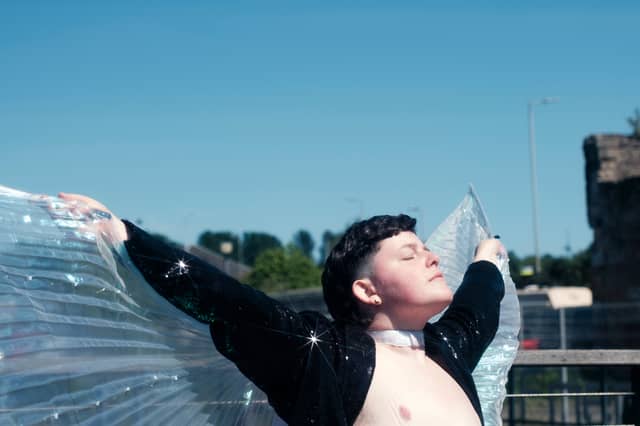

With a lot of LGBTQ+ people feeling under attack, the pressure is on artists to “represent” their community in a positive way, but what if they want to do something more nuanced? By Arusa Qureshi
“Back in the 1980s and 1990s, representation for trans people in the media was bad,” says theatremaker Ros Watt. “They were the freaks, the weirdos, the murderers, the stalkers, the ones you need to look out for, who are in disguise.”
Things have changed, he acknowledges, but representation can also become restrictive when the demand for positive images leaves no room for contradiction.
“We've almost tipped too far the other way,” says Watt. “Until we can capture the nuance of the fact that trans people can be bad because humans can be bad, then is that true, authentic representation?”
This is the tension that sits at the core of Watt’s debut show Trans People Are Awful, whose deliberately provocative title immediately challenges the audience’s expectations. Watt is not interested in making a “horrible trans person”, he says, but “an awful person, who happens to be trans”.
The distinction is crucial. The show’s central character is not intended as a symbol for all trans people, nor as a corrective to negative stereotypes. He is simply allowed to be a person, albeit an extremely violent and morally repellent one. The joke, and the provocation, lies in the title’s refusal to grant the audience the reassurance they may expect from a show about a marginalised community. It asks what happens when the “good trans” character is removed from the equation altogether.
Enjoying The Scotsman's coverage of the Edinburgh festivals? For just £2 a month you can get unlimited access to scotsman.com plus 2-for-1 Fringe tickets. For details visit www.scotsman.com/subscriptions
That pressure to be good, however, is not limited to fiction, and it’s something that performer and drag artist Nelly Kelly recognises innately. In Transmission, co-created with award-winning theatre director Susan Worsfold and creative access collaborator K Biff Nicolson, Kelly takes aim at the “good gay” or “good LGBT character” – a tradition that has now been extended to the “good trans” person.
“There’s a lot of pressure, not even in portraying characters, just in life, for trans people to be the good trans, be great representation all the time,” says Kelly. “And I know myself and a lot of other trans people have, at various points in their life, really tied themselves up in knots about trying to be this perfect person, which obviously is completely impossible.”
The result, Kelly argues, can be profoundly stifling. “None of us are perfect, and I think the message of the play is actually let's try and resist trying to be perfect.”

That messiness is key to Transmission, the idea for which came from a conversation jokingly had with another artist about the sudden appearance in the media of stories about a supposed “trans cult” in Scotland. The concept evolved into a satire about political manipulation, in which Kelly plays ‘Big Jimmy’, a right-wing politician who builds a renewed public profile by claiming that the trans cult exists and that he has proof. The show’s premise is absurd, but its basic question is serious: who gets to define a marginalised community in the public imagination?
If Trans People Are Awful challenges the expectation that trans characters must be morally exemplary, Transmission challenges the idea that trans people should have to accept the terms of a debate constructed around them. The question of who gets to tell LGBTQ+ stories is also significant to psychodrama Buggers, although writer and actor Alistair Hall approaches representation through historical intimacy rather than contemporary political satire.
The play focuses on Francis Bacon and George Dyer, whose turbulent relationship profoundly shaped Bacon’s work. But Buggers is not intended as a conventional biopic.
“I've been wanting to take them from our history, dismantle their relationship, and present something that feels very intimate and human, and naturalistic, and raw,” says Hall, “so that anyone can feel like they could be Bacon or they could be Dyer.”
That desire to bring historical queer figures down from the pedestal of art history is part of the play’s power. Hall is less interested in presenting Bacon and Dyer as icons than in showing them as a couple.
“When they met in 1963, homosexuality had not yet been decriminalised,” he says. “I was interested in the audience becoming a fly on the wall to Dyer and Bacon at home together, and us seeing their domestic space as a safe place to express desire, emotion, sexuality, because it's the only place that they can.” The domestic, in this context, becomes political. A relationship between two men is not presented as an issue to be explained, but as a lived reality, which can be complicated, intimate, and imperfect.
Hall is drawn to what he calls “genuinely unconventional stories” and characters who exist “on the outskirts of mainstream society”. While researching the play, he visited Dyer’s grave in London and discovered it was in the same cemetery where a service had been held for a friend of his who had died by suicide.
“Here are two men, both queer, who are decades apart, but the struggle's the same,” Hall says. “Struggles with addiction, struggles with identity, struggles with abuse, struggles with mental health. It's the same.”

That sense of continuity – of queer lives separated by decades but connected by experiences of isolation and suffering – runs through all three shows. Yet the artists also acknowledge that making work from within a marginalised community can carry a particular burden. Kelly describes it as “really exposing just now as a trans artist to make work”, with artists placed under an “intense magnifying glass”.
There is, Kelly believes, a duty to community when that community is fighting for survival. But that sense of duty can also feel unfair. Artists are already dealing with barriers to funding, platforms and visibility, Kelly says. On top of that comes “the big weight of responsibility and duty of care to your community that other artists don't necessarily have right now”.
Their solution has been to involve trans community members throughout the development of Transmission, asking for feedback on the work and how it lands.
Watt, meanwhile, argues that the pressure needs to be redistributed. Trans artists should not be the only people expected to carry the responsibility for representation.
“The pressure is there whether we want it or not, and I think the pressure needs to shift off of us a little bit, and onto other people,” Watt says. “We need the men programming work to programme us as artists who are making work. If I want to make a show about baked beans, I should be able to make that show as much as ‘trans work’.”
That freedom is, perhaps, the central demand underlying all three shows: the freedom to be specific rather than representative; contradictory rather than exemplary; and funny, angry, sexual, difficult, messy or simply human.
For Watt, the ultimate aim of Trans People Are Awful is not to deliver a lesson. “First and foremost, I love theatre,” he says. “I love stories, and I hope more than anything that people come and enjoy it.”
But beneath that entertainment is a plea against isolation. Watt hopes audiences might leave thinking about community, loneliness and the people they have failed to reach out to. “I've made a show that I think would have given me enough strength to leave my hometown and pursue and find myself a lot sooner,” he says.
Kelly, too, wants audiences to leave with a renewed sense of togetherness. In a moment when social media and news can make it easy to become desensitised to suffering, Kelly believes that gathering together and allowing ourselves to feel can be a form of resistance.
“I think the main goal is just reaffirming the need for community and togetherness and messiness in these times,” Kelly says.
Hall has no single message he wants audiences to take away from Buggers. Instead, he hopes the play will make people reflect on their own relationships, desires and histories – and perhaps send them back to Bacon’s paintings, particularly the portraits of Dyer.
None of these stories offers the audience a model of perfect representation, but that is precisely the point. It’s not a case of learning the correct lesson about LGBTQ+ lives, but an invitation to encounter those lives in all their complexity. In a time when marginalised communities are so often reduced to symbols, perhaps the most radical thing an artist can do is insist on making room for the full, unruly range of human experience.
Trans People Are Awful, Pleasance Courtyard, 3.30pm, until 31 August
Transmission, Summerhall, 18-23 August, 7.15pm
Buggers, Pleasance Courtyard, 1.20pm, until 30 August
The Scotsman’s arts newsletter is now sent twice a week - subscribe today
Enjoying the Arts & Culture journalism on scotsman.com? Make it easier to find by selecting us as a preferred Google source
Want the latest Scottish headlines sent directly to your phone? Sign up to our new WhatsApp channel here
Comments
Want to join the conversation? Please or to comment on this article.