
Dr Benji Waterhouse on finding the funny in psychiatry: 'The NHS runs on gallows humour'
Psychiatrist, comedian and now bestselling author Dr Benji Waterhouse on how his various careers inform each other and why his Edinburgh Fringe show is your best chance to see an NHS shrink without a 12-month wait
Psychiatry and comedy have more in common than you might think: both are about connection, listening closely and sometimes even healing. Unfortunately, they also both involve awkward silences, walk outs, and occasionally even deaths. Although I’ve never bombed so hard on stage I ended up in Coroner’s Court.
It’s no coincidence that I started stand up around the time I began training as a psychiatrist. There’s something daunting about discovering you now have the legal power to section people, essentially abducting them and injecting them with strong antipsychotics, without going to prison. Dermatologists don’t have decade-long debates about whether dandruff is even real. No one is ever involuntarily moisturised.
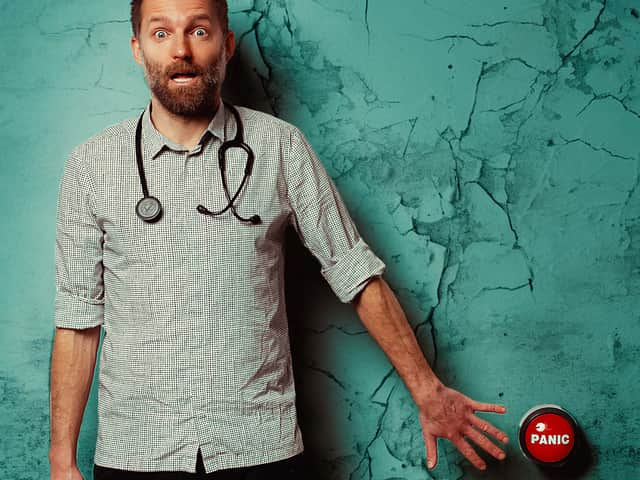

Public perception of psychiatry is still based on One Flew Over the Cuckoo’s Nest. Despite a PR push and slightly better haircuts, we still have the same locked doors, understaffing, overmedicating and yes, even electroshock therapy as the 1970s. Only nowadays, you get put to sleep first. Sometimes I still wonder if I’m just another barbaric psychiatrist on the wrong side of history. Naturally I cope with these big moral questions by … writing jokes about them.
The NHS runs on gallows humour – along with strong tea – to cope with the inherent pain, sickness and death in our work. I’ve learnt you can find lightness in even the darkest of places. For example, once I was so tired that on some section papers, I accidentally mixed up the boxes for the patient’s name and my own and technically detained myself. A sleep-deprived geriatrician colleague told me that he completed so many cremation forms, that following a similar mix-up, he once confirmed his own death.
Joking doesn’t just benefit staff. Sometimes patients need it, too. A few years ago, I found myself on the other side of the doctor’s desk after I fell down a hill and broke all my fingers like breadsticks. Lying on the theatre table I anxiously told the scrubbed-up surgeon that I’d never had an operation before. “Oh, I’ve never done one before either,” he replied. “But don’t worry, I’ve watched some videos on YouTube”. It probably wouldn’t win Dave’s Joke of the Fringe (RIP) but it instantly worked in relaxing me.
An understanding of human nature can be invaluable on stage. Now I’m a psychiatrist, I know that if anyone ever heckles me it’s just because they didn’t get enough attention as a child. When I first started on the open mic scene someone shouted: “You’re the worst comedian I’ve ever seen!” And I just thought: “But what’s this really about?”
Even the most brutal comedy put-downs are nothing compared to what I get at work. The other day when I wouldn’t let an unwell patient leave the locked ward he yelled: “You’re just a middle-class white boy who probably decided to be a psychiatrist after your mum once forgot you from cricket!” I had to clarify that it was actually my au pair.
Make sure you keep up to date with Arts and Culture news from across Scotland by signing up to our free newsletter here.
Last year I wrote You Don’t Have to Be Mad to Work Here, a fly on the padded-wall account of NHS psychiatry which looked to humanise the people beneath the labels we use and bust some myths along the way (ie, there aren’t any padded walls). It did fairly well and even got a glowing five-star review in the Daily Mail, so I take back anything I’ve ever said about those guys. Turns out they really know their stuff. It was also number two in the Sunday Times bestseller list and I doubt I’d have got people around the world to read as enthusiastically about suicide and schizophrenia without some jokes in there.
Similarly, my Edinburgh show this year, Maddening, uses sensitive punchlines to explore triggering themes ranging from homicide to electroshock therapy and perhaps most disturbing of all, people who say: “Have you tried yoga?”
It combines chapter readings, stand up and an audience Q&A, which is really just people’s best chance to speak to an NHS psychiatrist without the 12-month wait.
The dopamine rush from a roar of laughter is lovely, but when readers or audience members say you helped them out of a dark place? That’s even better.
They say laughter is the best medicine, though for depression, some of my early audience members might have preferred Prozac. The NHS is now even set to formally offer “Comedy on Prescription”, but is tickling the nation’s funny bone really the solution to the mental health crisis?
Of course, people love simple solutions. They’ll ask: what’s the secret to happiness? I say: “It’s really very simple. All you need is a healthy birth, secure attachment, relatively happy childhood, no trauma or high resilience, loving friends, family and partner, fulfilling work, financial security, manageable targets, eight hours' sleep, regular exercise, healthy diet, moderate drugs, alcohol and stalking your ex on Facebook, plus or minus antidepressants, therapy and 100% charge on your phone."
And if that doesn’t work, then like me you could always try stand-up comedy and audience validation.
Benji Waterhouse: Maddening, Pleasance Courtyard (Venue 33), until 25 August. His book You Don’t Have to Be Mad to Work Here (Vintage) is now available in paperback
Comments
Want to join the conversation? Please or to comment on this article.