
'It’s what I love most about all arts' - novelist Ali Smith on the composers turning her books into a concert
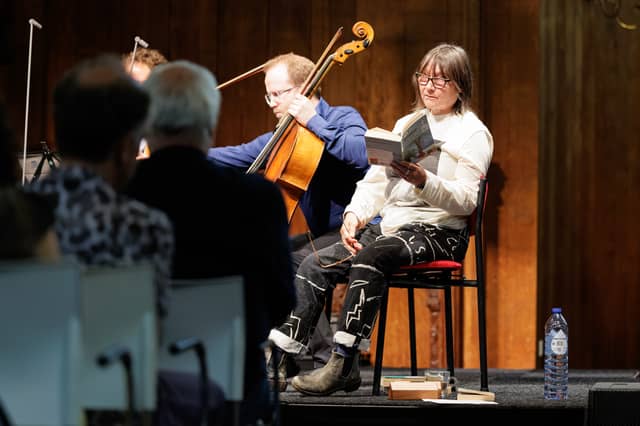

As the Edinburgh International Book Festival stages a concert inspired by Ali Smith’s quartet of novels Autumn, Winter, Spring and Summer, Susan Nickalls talks to the author and the composers about bringing it to life
Serendipity comes up time and again in Ali Smith’s books, Autumn, Winter, Spring and Summer. It was also the invisible force that propelled the Seasonal Quartet concert into being. It features the Netherlands-based New European Ensemble performing four new works inspired by the books, with live readings of extracts by Smith, as part of the Edinburgh International Book Festival.
The programme emerged out of a seven-hour stage adaptation of Smith's seasonal books by the Dutch National Theatre last year, the author explains. "It was a brilliant production, a real piece of joy. But although the New European Ensemble commissioned pieces for this, the theatre production went in a different direction and these tremendous and powerful new pieces of music became their own separate project. It feels very natural that it did and yet also really remarkable. Being a part of it is thrilling and it’s what I love most about all arts. They’re at their best and most exciting when they meet up with each other, one form crosses into and cross-fertilises another."
A lover of all music, Smith particularly enjoyed working with the musicians. "It’s tremendous for me, getting to work with them so closely – so close that the cello, which I sit next to, literally thrums through me. These are fantastic musicians who work together like a dream, so disciplined and consummate and clever and inventive and warm, I aspire to what they do.”
Enjoying The Scotsman's coverage of the Edinburgh festivals? For just £2 a month you can get unlimited access to scotsman.com plus 2-for-1 Fringe tickets. For details visit www.scotsman.com/subscriptions
The admiration was mutual during rehearsals, with the musicians and composers equally in awe of Smith and her work. Although the four female composers originate from countries around the world, they’re based in the Netherlands and have worked with the ensemble before. Kate Moore is Dutch/Australian, Alice Yeung is from Hong Kong, Seung-Won Oh is South Korean and Sara Zamboni is Italian. Each composer was allocated a specific season and had the freedom to choose the passages to be read from Smith’s books. As a result, how the music interacts with the texts is very different in each piece.
The first book in the series, Autumn, was given to Moore – an uncanny choice as she discovered many connections between herself and the main character Elisabeth. “I’m almost the same age as her so the cultural references were familiar and in a bizarre twist, two scenes in the book could been taken from my life. The scene where Elisabeth tries to get a new passport is hilarious and parallels my own experience in Australia. They couldn’t get around my middle name, Elisabeth, spelt with an ‘s’ and not a ‘z’, and made the same spelling mistake in the passport twice, which caused havoc. The other one was when Elisabeth describes a book she read as a child, Jill’s Gymkhana. As a girl, I remember going to buy a book and the bookseller asking if I would read and write a review of that very book."
Moore says her piece, Fall Falling, takes its title from the passage in the book she found powerful and moving. "It’s where one of the characters is explaining that god is everything: the tree, the leaves, the leaf, the greenness in the leaf. Autumn in music in my mind is the buoyancy of the air, a coolness to the temperature and shadows turning. I’m extremely synesthetic, so I made my piece like a painting, as an improvisation on themes and colours. The piano part is like the tree’s structure with the other instruments providing the colours and the shading around it and the floating red leaves suspended in the air never quite reach the ground. For me the whole project was very satisfying and moving. It was interesting to see how the fragments from the books Ali reads between the music bring those glimpses to life, creating a different story removed from the novel.’
Sara Zamboni’s piece, Hymn to Timeless Melancholy. Hymn to an English Summer, takes its title from the last book in the seasonal quartet, Summer. In particular, a specific passage where the character Grace revisits a small church in the countryside where 30 years earlier she had met a stranger. She reflects on that carefree afternoon where they were able to share their thoughts and stories.
Zamboni says her aim was to connect the character and content of the book and the way it was written with her music. "Some parts of the story are linear, while others are frozen moments in time so the music often loops to respect the multiple layers in the book. I composed the piece in episodes and shuffled the order, so that when a melody or harmony comes back it’s not used in the same way. It gives the audience the space to fantasize about which element to follow and play a little memory game."
Although Summer is set in Covid times, Zamboni made the decision to reflect the most poetic and positive moments of the book without dwelling on the drama and disillusionment. "The book is full of characters who meet by chance and proceed, or just meet and say goodbye. This abstract theme of serendipity where you meet someone and click and share moments of joy is more interesting to me than the political aspects."
However, some of the other pieces the ensemble will perform resonate with many of the contemporary issues in the books such as climate change, migration, Brexit, war and populism. For instance. Essays on Solitude by Syrian Kinan Azmeh connects to the theme of refugees in Smith’s book Summer, while Icelandic composer Anna Thorvaldsdottir’s Spectra relates to nature and our relationships to huge landscapes and ecosystems – topics featured in both Autumn and Winter. And reflecting a thread running through all four books about how we live now, is A Sad Paven for These Distracted Tymes by Peter Maxwell Davies, based on the Thomas Tomkins 1649 work with the same title. It just goes to show that just like the seasons, our current distractions are nothing new.
Seasonal Quartet by Ali Smith and the New European Ensemble is at Greyfriars Kirk, 28 August, 7pm, as part of the Edinburgh International Book Festival, as well as Cowdray Hall, Aberdeen, on 30 October at 8pm.
The Scotsman’s arts newsletter is now sent twice a week - subscribe today
Enjoying the Arts & Culture journalism on scotsman.com? Make it easier to find by selecting us as a preferred Google source
Want the latest Scottish headlines sent directly to your phone? Sign up to our new WhatsApp channel here
Comments
Want to join the conversation? Please or to comment on this article.