
The Mirror of Great Britain by Clare Jackson review: 'a detailed account of our most multifarious monarch'
Clare Jackson’s excellent biography of James VI and I suggests a man who was accomplished at playing a variety of different roles, writes Stuart Kelly
It seems to me somewhat strange that the 400th anniversary of the death of the first king to rule both Scotland and England (and technically Ireland, a foothold in France and a colony in America as well) should have had so little by way of commemoration. The reason, perhaps, lies in the final sentence of Clare Jackson’s excellent biographical study: “James VI and I was indeed the first king of Great Britain; he was also, by far, its most interesting”.

“Interesting” covers a lot here. James was complicated and contradictory, ambiguous and ambivalent. He lacks the tragic glamour of his executed mother and his executed son; nor does he have a convenient stereotype like Good Queen Bess, bluff and bloated Henry VIII or the unamused Victoria. All of this makes James a difficult subject, even before other factors are considered. There is indubitably an element of anti-Caledonian prejudice in some accounts of James and his reign, and there is an equally strong Whig perspective (not wholly incorrect) that sees James as the beginning of the Stuart absolutism, extravagance and moral laxity that would necessitate the Glorious Revolution.
This year has already seen a fine book about James by Gareth Roberts, which used the lens of personal relationships to structure the life (and had a title, Queen James, which belied its judicious tone). This biography by Clare Jackson, an Honorary Professor of Early Modern History at Cambridge, takes a different approach. Although it is, broadly, a cradle to grave account of James, chapters have particular focuses, allowing for a more detailed account of our most multifarious monarch. It has what one would expect – the Ruthven Raid, the Gunpowder Plot, the infatuation with Buckingham – and a great deal more: the importance of hunting, his appetites and illnesses, even (with the case Earl of Exeter v. Lakes) his role as the last monarch to sit personally in judgement.
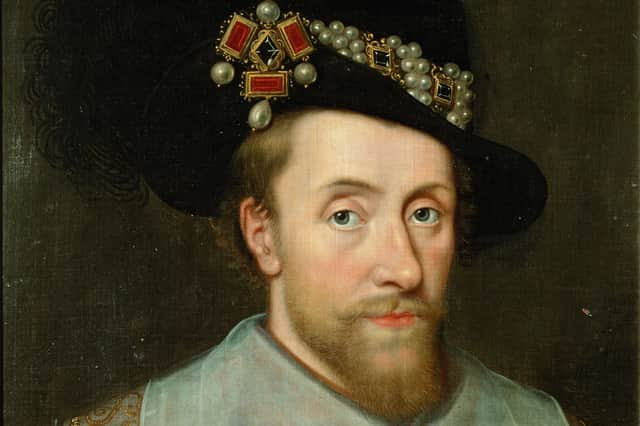
The title here gives a smart wink to the Renaissance genre, the “mirror of princes”. Although rooted in antiquity with texts like Xenophon’s The Instruction of Cyrus, essays on statecraft engaged the finest minds, including Erasmus, Luther, Castiglione and, notoriously, Machiavelli. John Skelton, the first English poet to call himself a laureate, wrote a Speculum Principis for the future Henry VIII. James was both the recipient of such a work – his tutor Buchanan’s De Jure Regni apud Scotos - Or, A Dialogue concerning the due Priviledge of Government in the Kingdom of Scotland – and the author of one, Basilikon Doron, mostly concerned with proving Buchanan wrong. But the title here, as Jackson expounds and expands it, cover mirrors throughout his life. There is the glass held up to show the future kingly descendants of Banquo’s son Fleance in Macbeth, and the hat jewel of three diamonds and a ruby worn in James’s first full length portrait as King of England. James frequently referred to mirrors in his speeches and writings: his wishes were “a mirror which is clear and unpolluted”, “let your life be a lawbook and a mirror”, “I heartily wish my breast were a transparent glass” and more. This is just one example of the proper close reading and enviably broad range of reference that Jackson employs.
Jackson also firmly presents James as both our most literary and most bookish monarch. There was some mild flak when the Jacobean playwright and court masque writer Ben Jonson published, in 1616, The Workes of Benjamin Jonson, since “Workes” seemed to put Jonson on a level with the (dead) classics. But James used a similar format in the same year for his The Workes of The Most High and Mightie Prince, James. This was his works in Scots and English, including his polemics against tobacco, instructions for poets and the notorious “Daemonologie”. It did not include – but Jackson does discuss – his epic poem “Lepanto”, which I’ve girned about being overlooked in the past. It is remarkable that it was paraphrased by Guillaume du Bartas, the pre-eminent French poet of the day (who called James the “Phoenix Escossois”), as well as being translated into Dutch and Latin. Jackson even detects a possible allusion in Othello. Othello refers to “a malignant and a turbaned Turk”, James to “circumcised Turband Turkes” – conspicuous because “turbaned” is one of James’s many neologisms. The OED credits him with, among others, Anglican, anorexia, Highlander, meat-eating, preening and quintessence. In terms of royal writing, James is a far cry from Sarah Ferguson’s Budgie the Little Helicopter.
READ MORE: Exile: The Captive Years of Mary, Queen of Scots by Rosemary Goring review
James also prided himself as a theologian: the Works include his meditation on the Lord’s Prayer, and his sermons on the Book of Revelations and of Chronicles. He gloried in his multiplicity: baptised a Roman Catholic, educated by a Calvinist, commissioner of the great Anglican translation of the Bible. The close attention is a microscope on James as a ruler intent on finding middle ways. His navigation between recusant Catholicism and republican Puritanism, between various European powers in fractious alliances and outright war, show skill rather than indecision. He may well have learnt more from Elizabeth’s deferring, prevarication and hedging than he admitted.
The more I read about James – and this ingenious book only heightened this – the more I wonder how much his statecraft was stagecraft. The various accounts by foreign diplomats, courtiers, favourites and foes almost seem to be describing a different person. That, or one person who was very accomplished at playing the necessary roles.
The Mirror of Great Britain, by Clare Jackson, Allen Lane, £35.
Comments
Want to join the conversation? Please or to comment on this article.