
The Great When by Alan Moore review: V for Vendetta writer's new novel is 'more Tim Burton than David Lynch'
Telling the story of a teen in late 1940s London who discovers a book from an alternate reality, Alan Moore’s new novel is full of ideas but suffers from woeful verbosity, writes Stuart Kelly


There is a school of thought which argues that given Alan Moore has written V for Vendetta, Watchmen, Batman: The Killing Joke, From Hell and The League of Extraordinary Gentlemen, he can do no wrong. It is not one to which I subscribe. The aforementioned works do merit the description “modern classic”; his previous venture into prose, Jerusalem, might best be described as a thousand page outsider art experiment, a chaotic come-all-ye. For every genuine and poetic insight – and they are there, I have quoted one of them on diversity among parliamentarians (there are still no poor ones) frequently – but it takes a heck of a lot of sifting to find them.
This new novel has had its hair combed and its tie straightened for the market, or sentencing. Readers should be aware that it is the first in a projected series, so narrative closures are necessarily provisional. It is a relatively standard narrative, with nods to theoreticians like Tzvetan Todorov, Mikhail Bahktin, Vladimir Propp and, of course, Joseph Campbell’s The Hero With A Thousand Faces.
Dennis Knuckleyard is the 18-year-old hero with a pseudo-19th-century name, who lives off the books in a second hand bookshop in 1949, run by the grotesque “Coffin Ada”. Her nickname, of course, transpires to be inspired by something other than her chain-smoking. He acquires a book amongst a job lot of Arthur Machen volumes from another dealer – A London Walk: Meditations in the Streets of the Metropolis by one Rev. Thomas Hampole. This gives Ada an even bigger fit of the screaming abdabs than discovering that Dennis has been abusing himself over vintage photographs he doesn’t realise are of her, (no doubt to anachronistic strains of The Who’s “Pictures of Lily”). The book shouldn’t exist in our reality, since it comes from a story, “N”, in Machen’s The Cosy Room and Other Stories, which deals with an alternate, parallel London.
Dennis has two friends – a suave lawyer, Clive Amory and a louche journalist, Tolerable John McAllister – but it is a prostitute, Grace Shilling, who proves most use in his quest to get shot of the mystery book. As is necessary, the book is also sought by a notorious villain, Jack Spot (so name for the ‘of bother’) and his sidekicks, Sonny the Yank and Solly the Turk. Losing rather than gaining the artefact means Dennis finding the painter Austin Spare (genuine) and breaching into the Great When. One of the best pieces of writing in the novel is also the most succinct: “If this London is what they call the Smoke, then that place is the fire”.
Moore credits Iain Sinclair and Michael Moorcock (authors of White Chapell Scarlet Tracings and Mother London) as inspirations, but could have added China Miéville (the detritus monsters in Moore are very similar to the binjas and Brokkenbroll in Miéville’s Un Lun Dun) or the criminally neglected The Speakers by Heathcote Williams, or even Peter Ackroyd’s Dan Leno and the Limehouse Golem.
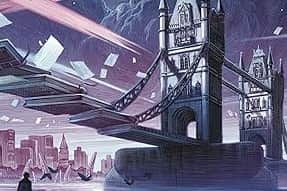
Moore populates his Jungian fever dream of London with archetypes, such as The Beauty of Riots, Harry Lud, Maurice Calendar, the Infernal Saracen and the City Heads (such as the decapitated Cromwell and Swedenborg), as well as real individuals that intersect with it.
The Usual Suspects are all present or alluded to: the tipster Prince Monolulu, Jack Neave, Steffi and Kenneth Grant (so by extension Aleister Crowley), Tom Driberg, Thomas de Quincey, the Racliffe Murderer and – no show without Jack – the Ripper, revealed to be a monstrous “Pope of Knives” from this surrealist hinterland. I harboured a slight wish that esoteric things like the fight between the fighting ape Jacco Macacco and Tom Cribb’s bitch Puss would occur.
The problem is that in Moore’s hands all this is less like David Lynch and a lot more like Tim Burton. What has genuine frisson in the hands of Sinclair and Moorcock could, under Moore and with one significant exception, be repackaged for Disney+. That exception is exceptionally problematic. Moore also wrote Lost Girls, an erotic work about the iconic Alice (from Wonderland), Wendy Darling and Dorothy Gale. Here, Grace, whom Dennis thinks is older than him, is actually significantly younger; and has been a prostitute since the onset of her teens.
The real problem, though, is the prose. The graphic form imposed a degree of rigour, and although The Great When is more streamlined than Jerusalem it still has woeful verbosity. So undissolved sugar in a mug of tea becomes “diabetic silt”, “glucose sludge” and “crystallising mess” in just over a page. Or take this florid cadenza: “These habitués, gabardine galleons, loomed up from the nicotinic mists now and then on their veering course from bar to chair to toilets, possible zigzagging to avoid those fifth-pint literary phantoms crowding a half-empty hostelry, swerving the deathless farts of Dickens, Tennyson, Twain, Conan Doule and Chesterton that shimmered still, in air last ventilated during the Great Fire”. It’s like Crispinus being made to vomit his dictionary-words in Ben Jonson’s (London satire) The Poetaster.
By chance, I was reading an excellent essay by Marc Sobel in The Comics Review about a forgotten Moore piece, “I Can Hear The Grass Grow” from 1988. It made me realise how terribly quickly acid-trip psychedelia can become awfully passé.
The Great When, by Alan Moore, Bloomsbury, £20
Comments
Want to join the conversation? Please or to comment on this article.