
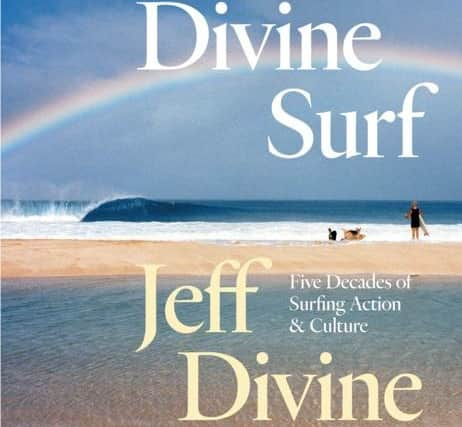
Divine Surf by Jeff Divine review: 'a sun-kissed journey through five decades of surf history'
As social media continues to erode our attention spans, this book is a welcome reminder of what it means to spend time looking at an image, writes Roger Cox



In the last three decades there has been a fundamental shift in our relationship with photography. Before the internet, we mostly experienced photographs as physical objects. It didn’t matter if it was a photographic print you’d just picked up in a paper wallet from Supasnaps along with 35 others, a photograph hanging on an art gallery wall or a photograph you’d seen reproduced in a magazine. Up until the turn of the millennium, for most people, most of the time, the word “photograph” meant something you could hold onto and – if you wanted to – consider in isolation from any other distractions for as long as you liked.
These days, however, we rarely experience photography in this way. For most people, photos are now something that exist in the digital sphere. In cyberspace, and in particular on our social media feeds, photos are no longer static – they are part of an endless, constantly-moving carousel of visual delights. Average dwell time on a photo posted on Instagram? Somewhere between two and three seconds. The tech bros and their algorithms have trained us to make faster and faster decisions about the kinds of images we like and the kinds we don’t. But somewhere along the way, have they also eroded our ability to spend time with a photograph, to take in everything the photographer is trying to show us, to get properly lost in an image?

In his 2019 book The Social Photo, Nathan Jurgenson suggests that concentrating on the “thingness of the photograph” is now an outdated way of looking at photography. “Our collective understanding of what a photograph means has yet to catch up [with social media],” he writes. “Traditional analyses of photography fixate on the photo object. This is the thingness of the photograph, as a discrete something with borders... The thingness of the social media image is undoubtedly still interesting, but its status as an object is not as central. As [José] van Dijk puts it, young people ‘take less interest in sharing photographs as objects than as sharing them as experiences.’” To the members of Generation Smartphone, then, photos frequently function as a form of communication, a bit like postcards did in the pre-digital age. “Enjoying the beach! Water’s lovely! Home soon!” Like many so-called “action sports”, surfing has fully embraced this, to the extent that the internet is now awash with surf photos; trouble is, there’s no quality control, no curation – just the tyranny of the algorithm.
It never used to be this way. Back in the 20th century, surf photography was largely consumed via surf magazines, whose picture editors agonised over selecting images that would give them an edge over the competition. Sure, maybe you did have to wait a month or two before you could see photos from a big pro contest, but once those images were available you drank them in, studied them, memorized them. And the quality control came as standard.
I’ve always been an avid consumer of printed surf media, but it was during my teenage years in the mid-1990s that I spent most time glued to the pages of UK surf mags like Wavelength as well US publications like Surfer. Perhaps that’s why, leafing through the pages of US surf photographer Jeff Divine’s new book, Divine Surf: Five Decades of Surfing Action & Culture, so many of the images were instantly familiar three decades on. Kelly Slater’s impossibly deep tube ride at G-Land, Java, in 1996? Already seared onto my mental hard-drive. Lisa Anderson’s laser-focused top-turn at Off the Wall in Hawaii in 1995? Also filed away under “effortless style”.
Divine got his first camera as a bare-footed teen in 1966 and was soon taking pictures of his friends surfing around La Jolla, California. By 1970, Surfer magazine had issued him with a Nikon camera and a 1000mm lens, and he was off to Hawaii, Mexico, Bali, South Africa and beyond, capturing images of the world’s best surfers riding the world’s best waves. What he’s able to present in this book, then, is a sun-kissed, salt-encrusted journey through the last five decades of surf history, as experienced by somebody who had a ringside seat for pretty much every significant plot twist.

Photo edited by long-time Surfer picture editor Grant Ellis, it is stuffed full of the kinds of action shots that demand careful study: Barry Kanaiaupuni fully committed to a warp-speed bottom turn at Sunset Beach, Hawaii, in 1971, the lip of the wave ten feet above him looking for all the world like an enormous, angry cobra; Reno Aberilla casually soul-arching across the top of a huge, frothing wall at Jeffrey’s Bay, South Africa, in 1977; Jericho Poppler Bartlow hanging a balletic five toes over the nose of her board at Haleiwa, Hawaii, in 1979.
Even more engrossing, however, are the images that transport you to another time and place: two vintage four-wheel-drive surfmobiles parked on the beach at Tamarindo, Costa Rica in 1979, their occupants checking the waves; or, even better, a group of surfers sitting on their boards between sets at Hollister Ranch, California, 1972, the just-out-of-focus water around them sparkling like only sea water on a hot day can. Would the algos ever have shown me that image? And if they did, would I have had the willpower to look at it for more than 2.5 seconds before scrolling on?
Divine Surf: Five Decades of Surfing Action & Culture by Jeff Divine, Rizzoli, £45
The Scotsman’s arts newsletter is now sent twice a week - subscribe today
Enjoying the Arts & Culture journalism on scotsman.com? Make it easier to find by selecting us as a preferred Google source
Want the latest Scottish headlines sent directly to your phone? Sign up to our new WhatsApp channel here