
Book reviews: Drystone by Kristie De Garis | Fascist Yoga by Stewart Home
It may be called Drystone, but there’s surprisingly little about wall-building in Kristie De Garis’s memoir, writes Stuart Kelly
One of my unexpected joys last year was Calum Robinson’s book Ingrained. I have almost no interest whatsoever in woodworking, but his account of the craft – its aesthetics and financing, its monetary and design value, tradition and entrepreneurship – was poetic, polemical and wise. I had high hopes that Drystone by Kristie De Garis would be in the same vein. The subtitle – “A Life Rebuilt” – promised ideas about resilience and fitting in, maybe even a nod to the great anarchist Buenaventura Durruti: “We can build others [buildings] to take their place. And better ones. We are not in the least afraid of ruins”. My grandfather was a dyker, along with a great many other traditional rural skills, and always claimed you never put a stone down once you’d picked it up (I always assumed this was folk wisdom about the patience of intuiting the right place, but he also said it was twice the work putting them down and picking them up again). Unfortunately however, Drystone is a different beast entirely. Also: why not “drystane”?
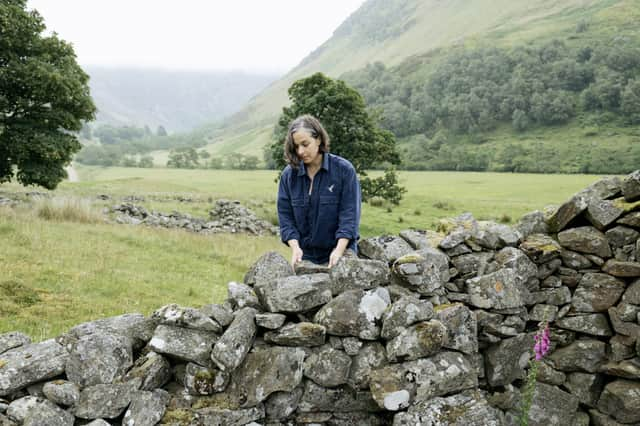

Whether you get along with this book can be ascertained by your reaction to a couple of sentences: “We would be a sober, platonic-throuple-parented, neurodivergent, anti-racist, anti-sexist, anti-COVID blended household. It felt surprisingly uncomplicated.” I don’t think many people were pro-Covid. Although each of the chapters is prefaced with a brief meditation on drystane dyking – the hearting, the throughs, the copes – the actual business of walls only come in properly roughly three quarters of the way through. The majority of the book is that old genre, the misery memoir; with a dash of the modern nature-cure twist from H is for Hawk, Raising Hare, The Fish Ladder and, er, The Salt Path.
READ MORE: The first 'shared passion' wildlife specialist bookshop in Edinburgh opens on grand cobbled street
Moving from Jedburgh to Caithness in a single-parent family and of mixed-race heritage, De Garis’s account of her life is a necessary and uncomfortable corrective to lazy narratives that see Scotland as being somehow less socially divisive than other places. As such, this has the virtue of testifying. It also describes a problematic relationship with alcohol, low self-esteem and the accompanying tendency to look for approval in unhelpful places. I hope that some of the men De Garis describes feel more than a twinge of shame, should they read this. She is eventually diagnosed with ADHD. An explanation, however, is not a justification. De Garis says it gave her “a whole new level of self-acceptance” and it is both why “where others felt fear, I did not” and why she was susceptible to reckless behaviour. I am very chary about diagnoses being used as totalising solutions – can one thing account for both selfishness and selflessness?
Life-writing relies on trust, but also on a kind of amicability. Maybe it is my defective personality, but lines like “I’ve dropped out of university seven times but I would make an excellent eccentric professor” or “Because there is one thing I know after everything and for ever. My chat? My chat is immaculate” just leave me – well, a little sad. It has a tone of needy self-regard. Anything outside of solipsism interests me, but questions I had – do dykers have a signature style? which stones simply can’t fit? how does a dyke become an ecological niche? – are not even raised. I put it down and picked up Hugh MacDiarmid’s “On A Raised Beach” - So these stones have dismissed / All but all of evolution, unmoved by it, / (Is there anything to come they will not likewise dismiss?)” He at least provides the Zen of stonecraft.

It would be a fair supposition that the art of crafting drystane walls has an element of “mindfulness” about it, and De Garis does give a glancing sense of this. She also, as mentioned above, is “Covid informed”, although I’m unsure what that means. Covid and mindfulness also intersect in a new work by the legendary Stewart Home. (I was glad to see Edinburgh-based Leamington Books have republished Pure Mania, and the Aberdeenshire, Pictish un-picturesque of 69 Things To Do With A Dead Princess makes him an honorary Scot in my book). His new work is a hilarious grenade thrown at platitudes and what my aforementioned Papa would have called the knit-your-own yoghurt brigade.
Although yoga plays on a degree of Indian orientalism, the origins of the “postural practice” are wholly Western, just cheaply gilded. Home cover various con artists, Satanists, serial liars, cheats and far-right fellow-travellers who found in the idea of “yoga” a useful idiot. It was, of course, Aryan (ie: white) and relied on innate superiority of spirit. Starting with Pierre Bernard – or whatever he was really called – Home gives a genealogy of popular yoga, something more akin to Charles Atlas magazine adverts and patchouli scented Svengalis than anything actually to be found in Sanskrit religious texts.
As one would expect, it is irreverent, hilarious, pointed and – his detractors will hate this – well researched. If De Garis shows that the much-vaunted “all Jock Tamson’s bairns” pillar of Scottishness is perhaps not the whole story, Home lifts the magic carpet to reveal the tasteless chicanery. I want him to challenge Joe Wicks to a headstanding competition.
Drystone: A Life Rebuilt, by Kristie De Garis, Polygon, £14.99; Fascist Yoga: Grifters, Occultists, White Supremacists and the New Order In Wellness, by Stewart Home, Pluto Press, £14.99.
The Scotsman’s arts newsletter is now sent twice a week - subscribe today
Comments
Want to join the conversation? Please or to comment on this article.