
Afloat: Small Boats, Swell and Seaspray, by David Gange review: 'exemplary'
From Barbados to the Butt of Lewis, this book shows why small boats are a big deal, writes Roger Cox



We stand at a moment of unprecedented creativity among historians,” writes David Gange in Afloat, his exemplary new work of creative history. To be clear, that’s not creative history in the sense of being creative with the truth, but creative history as in combining first-person experiences with factual research in order to facilitate a deeper understanding of the past. It’s a shift in the way history is taught and written that isn’t without its share of controversy – Gange admits that he feels “all the excitement and neurosis of this moment”. If ever there was a book that justified this approach, though, Afloat is it.
For Gange, a historian at the University of Birmingham specialising in small rowed or paddled boats, creative history inevitably means getting wet. “To comprehend the worlds I feel urgently compelled to learn about,” he writes, “I need to immerse myself in swirling air and ocean, surround myself with past people’s workplaces on cliff edge and skerry, and travel the sea routes past families traversed.” For most historians writing in this area, a token day or two at sea might suffice. Gange, however, is not most historians.
In his first book, 2019’s The Frayed Atlantic Edge, he set out to completely reconceptualise the history of the British Isles, putting our archipelago’s western seaboard at the centre of the story as opposed to its inland towns and cities. In order to help make his argument, he paddled a kayak from Muckle Flugga at the extreme northern tip of Shetland, all the way to Seven Stones Reef, some 15 miles west of Sennen Cove in Cornwall’s far south-west, tackling some hair-raising conditions along the way. The resulting mixture of conventional research and boat-gleaned wisdom helped him make a convincing case that, in the grand scheme of things, the Atlantic coast has indeed been pivotal to the story of these islands, certainly for far longer than our relatively recently developed urban centres.

In Afloat, Gange’s small boat experiences make an even more important contribution to his central argument, namely that “the cultures of coasts have been unique in their perspectives on past, present and future” and “we urgently need these [perspectives] if our societies are to flourish.” Gange also sets out to show that, while it’s usually the “big ships” that feature in historical records, often because they are carrying large cargoes which need to be recorded due to their value, it’s frequently been small boats, propelled either by paddles or oars, which have facilitated the development of coastal communities all around the Atlantic, allowing small-scale fishing and knitting together clusters of settlements otherwise difficult to access via land. To properly understand these communities, then, you must first understand the boats that made them, so that’s what Gange sets out to do.
The core of the book consists of a series of eight visits to different coastal areas, each of which focuses on a different type of boat. In Connemara in the west of Ireland, Gange goes in search of the so-called “Donkey Boat” – a rowing boat designed to work well in rough seas which, while largely forgotten today, was once vital for transporting peat and people in shallow, often stormy waters; on the Isle of Lewis, he learns about another surf-adapted rowing boat, the “sturdy but nimble” sgoth Niseach; in Sápmi, the homeland of the Sámi people of northern Scandinavia, he delves into an incredible history of boatbuilding, involving vessels made by stitching pine planks together with roots; and in the Faroes he discovers a whole subculture that revolves around communal rowing.
READ MORE: Do Blue by Nick Hounsfield & Abby Richardson review: 'an easy-to-digest primer on blue health'
Continuing west, he looks at the importance of the qajaq in Inuit culture and also the larger and less well-known umiaq; in Newfoundland he writes of the huge fleet of little rowing boats like the Bay Punt, some 19,000-strong, which used to maintain 30,000 people in around 300 fishing communities fishing known as “outports” until the government began a programme of centralisation; in Maine and Massachusetts he finds a culture of small wooden boat building that is still very much alive and thriving; and in Barbados he dives into the history of the “Moses Boat” – the modest, adaptable vessel that has been the island’s go-to fishing boat for generations.
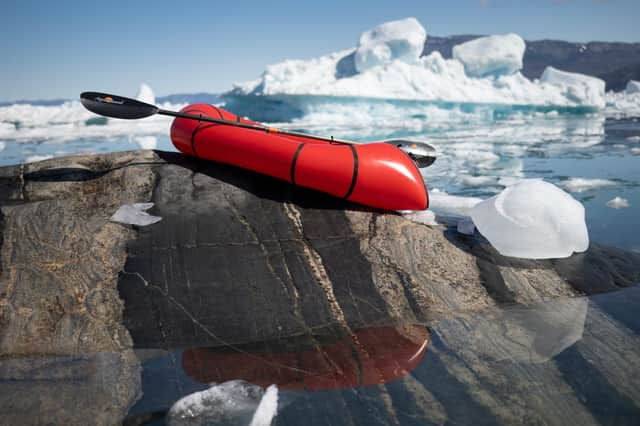
Some of the coastal journeys Gange undertakes are incredibly ambitious, whether using the historic boats he’s writing about, a borrowed sea kayak or, in a couple of cases, a tiny inflatable boat, just two metres long and weighing 1.2kg when packed away in his rucksack, which he describes as “more like an item of clothing than a vessel.” It’s difficult, in the scope of a review, to do justice to the magnitude of some of the adventures he describes, but imagine paddling a small red pool toy through a constantly shifting maze of giant icebergs, alone, for days on end, and you’ll get at least some sense of the scale of his Greenland epic. Even more impressive than his physical achievements, though, is the way he makes the case for the virtues of small, boat-based communities – poor in conventional Western terms, perhaps, but incredibly rich by other, arguably more meaningful measures. We would do well to study them, learn from them and attempt to apply a little of their wisdom.
Afloat: Small Boats, Swell and Seaspray, by David Gange, William Collins, £22
The Scotsman’s arts newsletter is now sent twice a week - subscribe today
Want the latest Scottish headlines sent directly to your phone? Sign up to our new WhatsApp channel here
Comments
Want to join the conversation? Please or to comment on this article.