
Venice Biennale 2026 review: 'full of contrasts and bold statements'
With a central exhibition featuring the work of 110 artists, not to mention 99 national pavilions and a whole host of “collateral” shows, the 61st Venice Biennale takes some seeing. Scotsman critic Susan Mansfield dons her most comfortable walking shoes and takes an epic journey through the world’s biggest art festival


“Take a deep breath,” reads the text on the wall as you enter In Minor Keys, the main exhibition at this year’s Venice Biennale. “Exhale. Drop your shoulders…” And you’ll need a deep breath, because if you see the whole show you’ll have walked several miles and viewed the work of 110 artists. And even then, you’ve barely started.
This year’s Biennale spirals out from here, with 99 national pavilions, a varied “collateral programme” and an ever-growing number of exhibitions which have no official connection to the Biennale itself, but run in parallel because, with close to a million art lovers visiting the city over the next six months, why not?

The invitation to breathe deep and chill out has been criticised, however, because so far the 61st Venice Biennale has been anything but chilled. Preview week was overshadowed by protests and petitions about the decision to include representation from Russia and Israel, culminating in the resignation of the jury for its Golden Lion Awards.
If the tone of In Minor Keys - slowing down, listening, encountering art as an oasis of calm and beauty - feels a bit at odds with the times, it could be because of the circumstances in which it was made. After the sudden death of guest curator Koyo Kouoh a year ago, the project has been taken forward by her team. Whether she would have made other choices as the show took shape, it’s impossible to know.
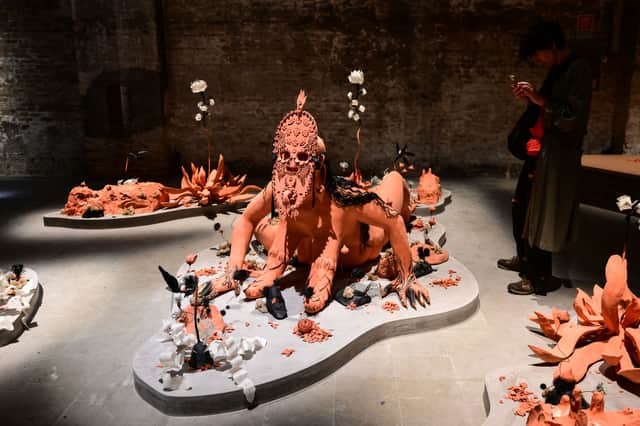
It’s a sprawling exhibition in which a web of themes unfolds with a degree of awkwardness. For all its talk of slowing down and listening deeply to “the quiet tones, the lower frequencies, the hums, the consolations of poetry”, it’s a busy show full of contrasts.
Otobong Nkanga softens the pillared frontage of the Central Pavilion in the Giardini with plants and vernacular bricks. Then, just inside the entrance hall, there is Big Chief Demond Melancon’s orange feathered costume, Amistad Takeover, made in the Black Masking tradition, with embroidered, beaded panels telling the story of the famous slave rebellion. Visually and conceptually, it’s a bold statement.
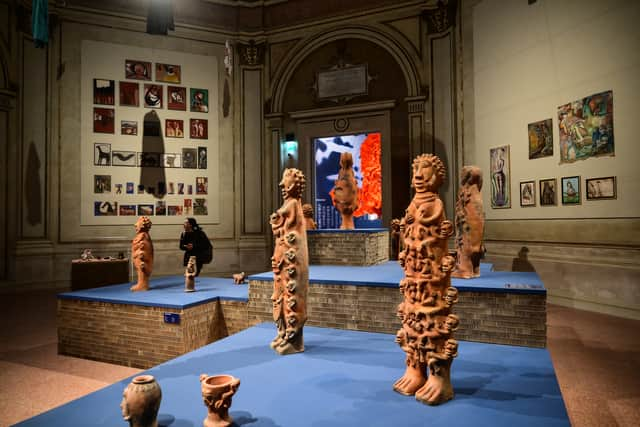
There are moments like this throughout: work which offers bold perspectives from beyond the Western canon, like the clay statues of Seyni Awa Camara and Celia Vasquez Yui’s parliament of ceramic beasts, The Council of the Mother Spirits of the Animals, a reminder of the centrality of the more than human. But these are only one aspect. The show’s two guiding spirits, Kouoh’s mentor, Senegalese artist Issa Samb, and Black American artist Beverly Buchanan, are joined by a third: Marcel Duchamp, shaking up the system from within.
Mostly, what unites the work in the Giardini is the quality of making, from artists like Wardha Shabbir, who takes the Pakistani miniature tradition onto a bigger, dazzling scale, the stitching and printmaking of Alexa Kumiko Hatanaka, Alice Maher’s drawing and installations.
It’s great to see the work of Glasgow-trained Pio Abad, including some of his lockdown ink drawings which juxtapose Benin bronzes with arrangements of objects from his London flat. Mohammed Joha’s collages of a ruined Gaza are understated and moving, and Indian photographer turned painter Sohrab Hura presents part of an ongoing series, Things Felt But Never Quiet Explained, which draw on the wonders of everyday life (and death).
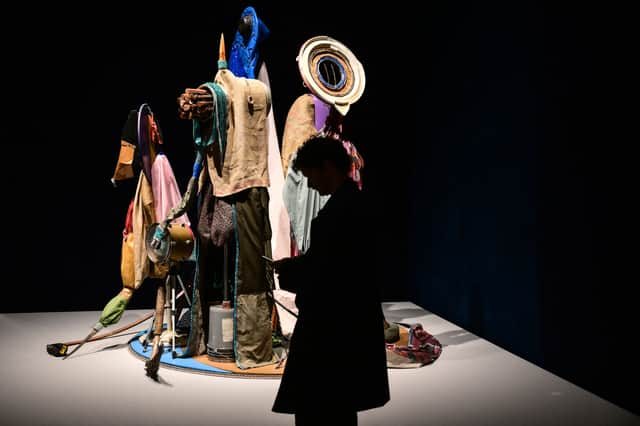
In the Arsenale, everything is bigger. There is a broadening of themes to include more history and more (much more) on land rights. There are more films. The sentinels are bigger too, from Daniel Lind-Ramos’ Guardaverde, to Guadelupe Maravilla’s Disease Throwers, spectacular totemic figures built from found objects and garden chairs.
There is some repetitiveness here, but there are also significant highlights: human/bird/plant hybrids by American sculptor Nick Cave; black and white photographs made on the streets of cities like Dakar and Bamako by Akinbode Akinbiyi; Rose Salane’s installation of rings found by the New York Transport Authority.
Cauleen Smith’s The Wanda Coleman Songbook celebrates the poet in an immersive four-channel portrait of LA with a jazz soundtrack, and is simply gorgeous. French artist Kader Attia builds an installation around the beguiling notion, posed by a Vietnamese shaman, that computer viruses are actually spiritual entities.
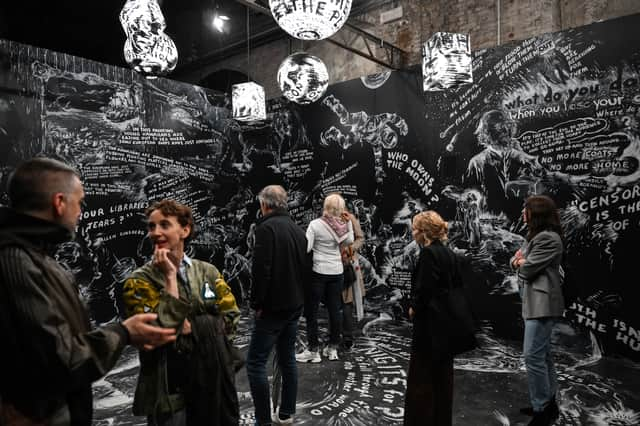
Alfredo Jaar, with a big space, a lot of red light and a tiny cube of rare minerals, is powerfully succinct about exploitation. Eric Baudelaire’s five-channel film made in an immense flower market in the Netherlands reveals a nightmare world of automation. If you make it right to the end - and this is by no means a given - you will be rewarded with a room of words and drawings from the notebooks of Laurie Anderson.
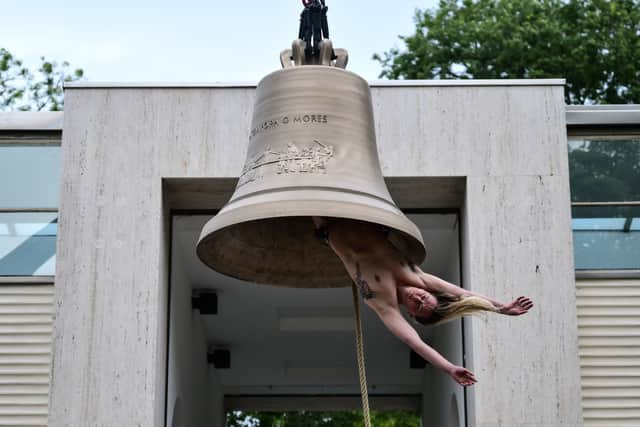
Out among the pavilions, the longest queues were for Austria where performance artist Florentina Holzinger rings a bell with her own naked body, while a woman scuba dives in a tank full of urine. Add to this Aline Bouvy’s film, La Merde, for Luxembourg, with its singing turd, and you have a definite undercurrent about facing up to one’s own shit, whatever that is.
Of the pavilions which have caused so much trouble, Russia - a disco, some folk singers and lot of flowers - closed after previews, and America - another candidate for cancellation - was simply dull, however shiny Alma Allen’s sculptures appear. Whether Israel’s pavilion will stay open is unknown; it was closed when I tried to visit, guarded by a phalanx of Italian police.
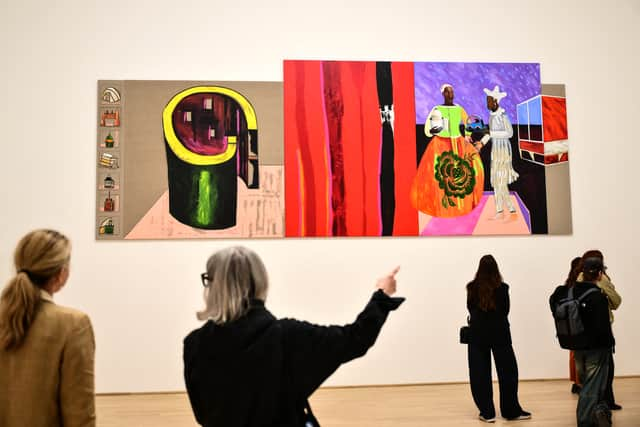
At the British Pavilion, Lubaina Himid has created an uneasy version of the UK with her paintings of Persons of Colour working hard in their various professions - cooks, tailors, architects - and a soundtrack or birdsong and bees buzzing which is just a fraction off-kilter. What are we doing here, the people in the paintings seem to ask? What is this country? And they may well ask.
Germany continues its perennial struggle with its Nazi-era pavilion. In a thoughtful show called Ruin, Sung Tieu disrupts the facade with tiling in the style of the block in which she grew up, housing Vietnamese immigrant workers in East Berlin. Inside, Henrike Naumann’s The Home Front explores a sense of nostalgia for the old East, with furniture and objects half-embedded in walls painted the green of a former Soviet barracks.
For Spain, Oriol Vilanova covers every wall, floor-to-ceiling, with a collage of old postcards, each representing an old story, a now-outdated way of looking at the world. Performance artist Miet Warlop has choreographed cheerful chaos in the Belgian pavilion in which plaster tiles bearing words are made and broken.
In the Arsenale, I enjoyed Isabel Nolan’s show, Dreamshook, for Ireland, in which tapestries, sculptures and drawings were inspired by the story of a Venetian humanist publisher from the 15th century, and Nomument Group’s show for Slovenia about the discovery of the foundations of a Mosque built in the Slovenian Alps for Muslim soldiers in 1917.
There was real beauty in India’s Geographies of Distance: Remembering Home, in particular in Sumakshi Singh’s recreation of the facades of her now demolished family home using white thread. Malta’s space includes a superb animation by Raphael Vella, Praying for a Revolution That Will Never Come, and Charlie Cauchi’s lifesize statue of Russell Crowe made from chocolate is worth seeing too, just because.

I love when a show at the Biennale gives you a flavour of elsewhere, as Kazakhstan does so powerfully with a monumental sculpture of horse heads made of felt and an immersive soundscape evoking the steppe. Wales in Venice does something like this too, if less dramatically, with artists Manon Awst and Dylan Huw reflecting on the threatened Welsh peatlands, and on minoritised languages and cultures. Rayna Teneva’s film Geography is Destiny, for the Bulgarian pavilion, also does this in its portrayal of the lives of the workers in that country’s Rose Valley.
All of the above are worth seeing, and of course Scotland + Venice’s show at Olivolo, Shame Parade by Bugarin + Castle, reviewed in The Scotsman last week. But if you get to Venice in the next six months, don’t miss the non-Biennale exhibition by Jenny Saville at Galleria Internazionale d’Arte Moderna, Ca’ Pesaro. A career-spanning selection of work shows a superlative painter at the height of her powers. Standing in front of her Blue Pieta, I knew I was in the presence of all that needed to be said about war and oppression, humanity and trauma and resistance. The biggest Biennale in the world could not say more.
Until 22 November, see www.labiennale.org
The Scotsman’s arts newsletter is now sent twice a week - subscribe today
Want the latest Scottish headlines sent directly to your phone? Sign up to our new WhatsApp channel here
Comments
Want to join the conversation? Please or to comment on this article.