
The dead don’t go until we do, Edinburgh review: 'art that takes the long view'
At a time when attention spans are growing ever shorter, the new exhibition at Talbot Rice invites us to look, listen and learn at a slower pace, writes Susan Mansfield

The dead don’t go until we do, Talbot Rice Gallery, Edinburgh ★★★★
Contemporary culture isn’t well suited to the long conversation. News and views are bite-sized, attention spans are said to be dwindling. There’s no time to explain background or history, to talk about roots. Those with long stories to tell, or a complex past, are in danger of being misunderstood, or just forgotten.
There’s a opportunity here for a certain kind of art practice which encourages the long view, either by in-depth research in history, geography, anthropology, or by the deep excavation of personal ancestry. What these artists do is akin to what Jackie Kay describes in the poem “Darling”, from which the title of the show at Talbot Rice Gallery is adapted: while there are people who remember, the dead are with us still.
There are four such practices in The dead don’t go until we do, curated by Talbot Rice’s James Clegg, each from a different continent. Each presents a substantial body of work, making this feel like four separate shows with a linking theme. All four are enacting a kind of remembrance, inviting the audience to look, listen and learn.
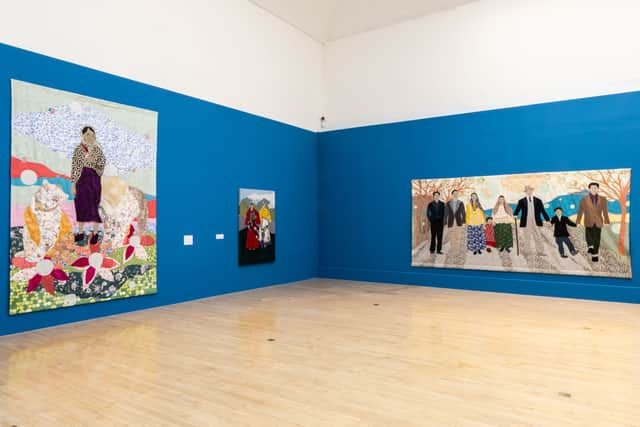
Małgorzata Mirga-Tas created a buzz when she made work for the Polish Pavilion at the 2022 Venice Biennale, bringing to life her Roma heritage in an immense feat of stitching. The majority of the works in her show here, ‘We won’t stay silent any longer’, have been made since then. Most are portraits in textile collage, some on a monumental scale.
Her subjects are her family and friends and other Romani people found in archives and photograph albums: people like Wanda Siwak, who hid her daughter from the Nazis, only to be imprisoned in a concentration camp herself, or the nameless female bear-trainer, photographed in Berlin in the 1920s, whose picture became part of a set used by the Nazis to find people to deport. Mirga-Tas’ friend, filmmaker Vera Lacková, smiles beside her young daughter. Three daughters of a great-uncle sit together on a cart. She also includes two poignant poems written by her uncle.
Using colourful fabrics, often taken from clothes made and worn by Roma people, Mirga-Tas softens and lightens, drawing out the humanity, shaking off the misconceptions that dog the community. In her pictures, these are proud, resilient people, close-knit families who support one another and have fun.
In three works from a longer series Out of Egypt, she remakes images from a series of etchings by 17th century artist Jacques Callot which both exoticised and denigrated the Roma subjects. That “gypsies” came from Egypt is just one more erroneous assumption. In her stitched works, they are quietly dignified, going about the daily tasks of life. The family travelling with a donkey echoes Old Master paintings of the Holy Family.
While this show isn’t the monumental accumulation of work which was in Venice, it is still impressive and heartfelt, not least in the investment of time and skill. Abstract backgrounds of stars and planets in some of the pictures hint at centuries of history and ancestry. Perhaps the pretty collaged fabrics make these works look almost illustrative, but that would be another misconception. They are deeply serious in their intent, they just happen also to deal with joy.
Mumbai-born Amol K Patil is also drawing deeply on his own past. His grandfather was a poet and singer who used his work to criticise British colonial rule and the caste system; his father a socialist playwright and theatre-maker. Patil’s work pays tribute to them while speaking out on behalf of those trapped by India’s caste system in dire poverty.
His film, Who is invited to the city?, which gives its name to the whole installation, is a play of darkness and light. On a dark screen, moving points of light suggest people in rural India who move to cities like Mumbai in search of a better life, only to find themselves trapped in other kinds of darkness. We hear the artist’s own voice and the sound of crickets chirping, while lines by Dalit poet and activist Namdeo Dhasal appear on the screen.
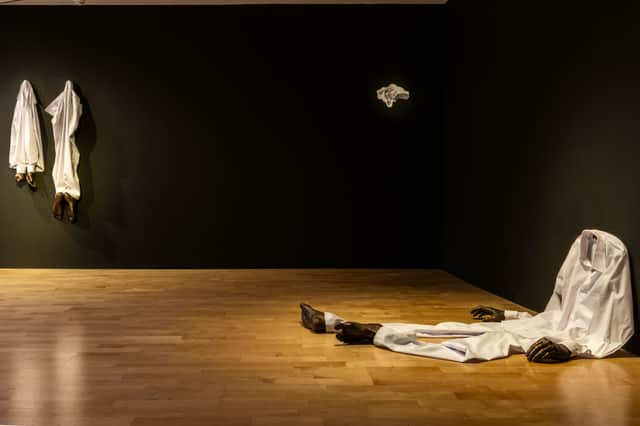
Elsewhere in the space, fine pencil drawings refer to life in the chawls, tenements built in the 1920s by the British to house Indian workers which became horribly overcrowded as the city population grew. White coveralls suggest the presence of low-caste workers regarded as barely human, spread on a table or hung on coat-hooks. It’s a clarion call, albeit a visual one, to consider those who are all too easy to forget.
Korea-born, California-based Kang Seung Lee is concerned with untold stories and secret spaces of queerness. In his installation in the Round Room, Erasure held like a fierce lantern, he engages in conversations with queer artists from other generations, echoing their work in his drawings, watercolours and embroidery which uses sambe cloth, traditionally worn in Korean funeral rites.
He makes pencil drawings based on photographs: pictures of the ocean by Peter Hujar and the Hudson river piers by Alvin Baltrop, both of whom documented sections of queer American life. And there are cast silver pieces based on the American Sign Language alphabet, which Chinese-American artist Martin Wong used to weave coded messages into his paintings.
For this show, he also references queer sites in Edinburgh, including Bristo Square, site of the world’s first international Gay Conference in 1974, and the Aids Memorial in Dean Village. Plants and rocks from these sites are delicately placed in the show, indications of the non-human world which operates on a different timescale to our own.
All of this is delicate and subtle; there are no explanations and there’s no placard-waving. Artists such as Hujar and Wong had to code their queerness in a way that is less necessary today, but Lee’s quietly fierce engagement with the subject is almost in another kind of code.
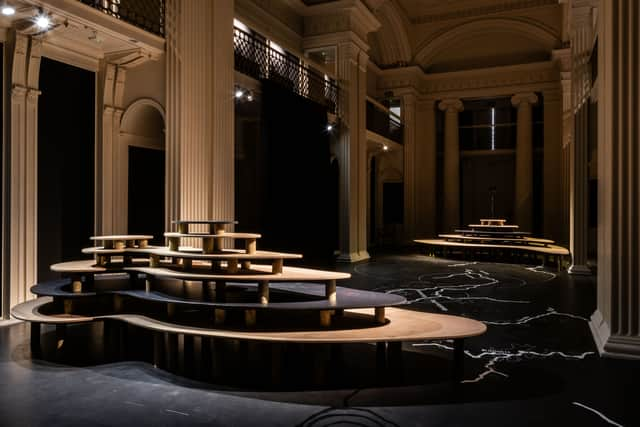
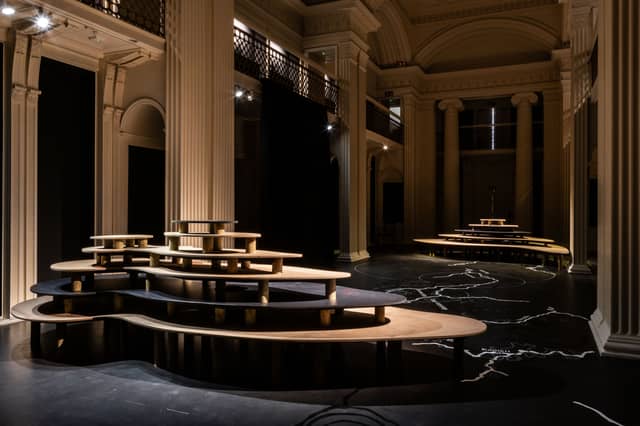
The last body of work, in the Georgian Gallery, takes us to Africa, where Johannesburg-based collaborative duo MADEYOULOOK are engaged with questions of relationship to land. The land in question is Mafolofolo, a settlement established by the Koni people in 1873, only to be abandoned three years later when they were displaced - part of a long history of displacements.
Artists Molemo Moiloa and Nare Mokgotho spent five years researching the area, where Koni earthworks, built across some 150km, have enabled plants to grow in otherwise arid plain. In the installation, they have recreated the land in a kind of 3-D map, with an ambient soundtrack of birdcalls, weather and African voices. Upstairs, short extracts from their publication Menagano pose questions about what a Black landscape aesthetic might look like.
There is a rigour to the presentation which makes no concessions to the audience. The languages are not translated. The acres of field notes on the land contours are mostly illegible. This is about experiencing the land, not surveying it or analysing it as a coloniser might. It’s about learning to experience differently.
MADEYOULOOK are very clear that their art is not going to interpret the land in a way which suggests another kind of colonisation. There are no explanations, nor should there be. Made you look? All four of them did. And think a bit too.
Until 30 May
The Scotsman’s arts newsletter is now sent twice a week - subscribe today
Want the latest Scottish headlines sent directly to your phone? Sign up to our new WhatsApp channel here
Comments
Want to join the conversation? Please or to comment on this article.