
Magnus Linklater on 'a hugely important moment' for Little Sparta


Ian Hamilton Finlay’s garden Little Sparta has been described as ‘the most important work of art made in Scotland in the second half of the 20th century’. Now its future looks secure, thanks to a combination of significant grants and generous donations, writes Magnus Linklater
As he approached his 70th birthday, the poet and artist Ian Hamilton Finlay began to wonder about the future of his greatest creation - Little Sparta, the garden he and his partner Sue had carved from the Pentland Hills over a 30 year period. They had made it, not only a thing of great beauty, but of international significance - its engraved sculptures, trees, pathways and pools coming together to create a single artwork.
To preserve its future, Finlay decided to create a trust, placing the fate of Little Sparta in its hands. He hoped the garden and its art would survive the wild winters and the changing seasons of the Pentlands, but, being a gloomy Scot at heart, he observed: “If it can’t be saved, then I hope nature and the hills can reclaim it.”
Having served on the Little Sparta Trust for 25 years, latterly as chairman, I believe Finlay would have taken heart from the progress now being made to safeguard the garden and to sustain it for future generations. Significant grants from the National Heritage Memorial Fund and Art Fund — the UK’s national charity for the arts — together with generous donations, have enabled us to acquire the famous Temple of Apollo, bringing the whole of Little Sparta into the Trust’s care for the first time.
This is a hugely important moment, not only in securing one of the most remarkable artistic landscapes of the late 20th century, but in laying the foundations to widen its reach and support its long-term conservation and restoration. We are now embarking on the most ambitious fundraising campaign in the Trust’s history, with the aim of opening Little Sparta to a wider public and introducing a new generation to the ideas and vision that shaped this remarkable place.
Its origins go back to the autumn of 1966, when Finlay, Sue and their six-month-old son Alec arrived at Stonypath, as it was known then, near Dunsyre in Lanarkshire. At that time, it was little more than a cluster of farm buildings belonging to Sue’s family, the MacDonald Lockharts, who had lived in the area for centuries. Sue’s father, Simon, gifted it to the young couple; their baby daughter Ailie would arrive the following year.
They began to create a garden out of the most unpromising surroundings. Sue recalls those early winters, when the winds howled across the hills, and they had to tie young saplings to sturdy posts to prevent them being blown over. “We knew nothing about gardening,” she admitted, “but my mother brought us plants from her garden and slowly I began to learn - and in time Ian saw the garden as another place to display his works in stone and wood.”

Gradually, Little Sparta, as Finlay named it, began to evolve, not just as a garden but an artwork in itself. Collaborating with stone carvers, letterers and at times other artists and poets, he placed sculptures and artworks - more than 270 of them eventually - throughout the six acres of trees, burns, ponds, paths and flower-beds, exploring themes as diverse as the sea and its fishing fleets, classical antiquity, the French Revolution and the Second World War.
The ideas he explored were often provocative. He called the garden Little Sparta, to emphasise it as a counterpoint to Edinburgh, the so-called “Athens of the North.” In Greek history, the embattled Spartans were always at war with Athens. Finlay took on what he viewed as the cosy arts establishment of Edinburgh and declared a cultural war against it. Some people, he said, thought of a garden as “a retreat.” He viewed it as “an attack” – re-arrange the letters of garden, he said, and they spell “danger.”
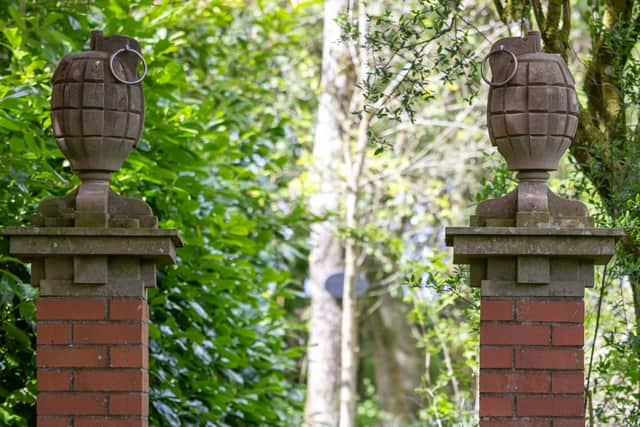
If that suggests Little Sparta is an uncomfortable place, nothing could be further from the truth. It has a dream-like quality, as little paths traverse rivulets, and trees conceal half-hidden figures, representing themes from Greek mythology, the English garden and French romanticism - almost every visitor talks of its calming effect. Every now and then, however, you will come across something that makes you stop and think: a couple of pineapples on top of two pillars turn out, on closer inspection, to be hand grenades; an elegant sculpture over-looking a lochan is in fact the conning tower of a nuclear submarine; a stone column with its upper half cut off recalls the Dido class cruisers sunk during World War II - their names are followed by a line from Virgil’s Aeneid, meaning “and they were stretching out their hands in longing for the farther bank.”
READ MORE: Royal Scottish Academy 200th Annual Exhibition, Edinburgh review: 'a wonderful miscellany'
And then, high on top of a bluff, overlooking the glen beneath, the visitor comes across a dramatic collection of fallen stones, spelling out a saying attributed to the French revolutionary, Louis Antoine de St, Juste: “The present order is the disorder of the future.” It is as apt a description of the troubled world we face today, as it was in 1789. Finlay once wrote: “The garden functions - as gardens have often functioned - as a political statement… [just] as it is possible to transform this hillside into a garden, so it is possible for man to transform the world, or society. It is an example of ACTION, and that is very important to me.”
Twenty years after his death, Finlay’s ideas have gained wider significance, and Little Sparta has become a place of world renown. In 2025, the centenary of his birth, no fewer than eight international exhibitions were held across the world to celebrate his creativity and the intellectual stimulus he brought to contemporary art. When, last year, the New York Times drew up a list of 25 “gardens you must see” across the world, it included Little Sparta, with one of the judges observing: “Some say it’s the most important work of art made in Scotland in the second half of the 20th century.”
The Trust hopes to build on that recognition by opening Little Sparta more fully to the wider world, creating new opportunities for people of all ages and backgrounds to experience and learn from this remarkable place. The generous funding we have received does more than secure the future of the Temple of Apollo. It provides the foundation for an ambitious development programme that will create learning and education initiatives, artists in residence, training in lettering and stone carving, and partnerships that support volunteering, skills development and employment in South Lanarkshire.
Little Sparta has much to teach us about art and landscape and humanity’s relationship with the natural world. When Monty Don visited the garden last year for his television series on Britain’s greatest gardens, he reflected: “I came away feeling it was more complicated, richer and in many ways more important than the expectations I had carried around with me for so many years. Little Sparta challenges the way we think about gardens, but it is, for all its complexity, obscurity and horticultural quirkiness, a complete and integral work of art and should be treasured as such.”
Finlay understood both the fragility of Little Sparta and the resilience required to sustain it. The responsibility of the Trust is not simply to care for the garden, but to ensure that it continues to inspire future generations. Support from the National Heritage Memorial Fund and Art Fund now gives us the opportunity to carry that work forward.
This is a moment of celebration and renewal. As Little Sparta opens for the summer season, we look forward to welcoming those who know and cherish the garden, and those discovering it for the first time. We hope visitors will be inspired by Finlay’s remarkable legacy and the possibilities that now lie ahead. Importantly, we hope they will join us in helping to shape the next chapter in the story of this unique and extraordinary place.
A major grant of £162,000 from the National Heritage Memorial Fund, alongside further support from Art Fund and other generous supporters, has enabled the Little Sparta Trust to acquire Ian Hamilton Finlay’s Temple of Apollo. As of May 2026, the entire site is now held in trust for the public in perpetuity, creating the foundation for long-term plans to protect, restore and share Little Sparta with wider audiences. The Trust is now preparing to advance its long-term vision and will launch a major fundraising campaign to support the conservation and restoration of the site, while creating new opportunities for people to engage with, learn from and be inspired by the garden and Finlay’s enduring legacy. The announcement coincides with the launch of Little Sparta’s Summer 2026 opening programme from 4 June until 27 September, inviting visitors to experience this remarkable place and to engage more deeply with the ideas that shaped this unique landscape, see https://www.littlesparta.org.uk
The Scotsman’s arts newsletter is now sent twice a week - subscribe today
Want the latest Scottish headlines sent directly to your phone? Sign up to our new WhatsApp channel here
Comments
Want to join the conversation? Please or to comment on this article.