
Exclusive:How an 'uninteresting' plaster bust of Charles I has been revealed to be link to long lost masterpiece
‘It has been hiding in plain sight’
It has long been dismissed as an “uninteresting” object, barely noticed by visitors to the Palace of Holyroodhouse, where it has been displayed for 25 years.
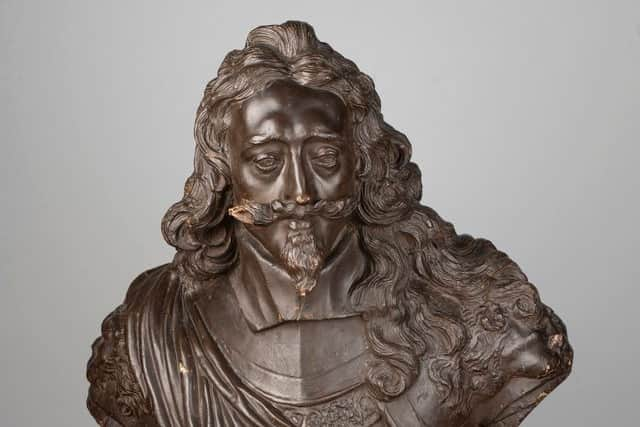
But the significance of a plaster bust of Charles I in the Royal Collection has now been realised following the discovery that it is a cast of a lost 1630s masterpiece by Gian Lorenzo Bernini. The work by Bernini, one of western art’s greatest sculptors, was destroyed in the fire at Whitehall Palace in 1698 and has intrigued the art world ever since.
Jonathan Marsden, former director of the Royal Collection and surveyor of The Queen’s Works of Art, made the discovery while researching the first comprehensive catalogue of sculpture in the Royal Collection.
He told The Scotsman: “Everybody wants to know what the ‘lost’ portrait bust looked like. Those who saw it at the time wrote in superlatives, but without being quite specific enough about what they saw… There are these ecstatic descriptions, [but] they're not particularly graphic… They go on about how wonderful it was without really describing it.”
Bernini’s sculpture was hailed as a masterpiece after it was presented in 1637 to Charles I, Henrietta Maria and their court, admired by one contemporary as “not only for the exquisiteness of the worke but the likenese and nere resemblance it had to the King countenaunce”. His reward included a diamond ring valued then at the princely sum of £800.

Mr Marsden said: “It’s a shame that, having survived the arduous journey from Bernini's studio in Rome to London or Windsor, a journey involving multiple modes of transport, cranes, and waggons, it then survived the Restoration, leaving and re-entering the Collection, it was destroyed in the fire at Whitehall Palace in 1698 because it was heavy and couldn't be rescued – unlike more portable paintings.”
He described its destruction as “one of the worst artistic losses this country has ever suffered”, adding: “Those who directed the fire-fighting operation were able to halt the spread of the flames without threatening the Banqueting House and its ceiling by Rubens, but no such architectural barrier was available to save the Bernini.”
He added that, as a result of this loss, Hubert Le Sueur’s portrait of Charles I came to be his definitive sculpted likeness, although “inferior in quality”. The plaster bust, 64cm high, is a life-size depiction of the king’s head and shoulders by an unknown sculptor.
As only the face was cast from Bernini’s portrait, it gives only an idea of the original, Mr Marsden said: “But people can feel they are just one or two steps away from the actual face of Charles I as depicted by Bernini.”
Bernini’s marble carvings are revered for an unparalleled virtuosity and, with Charles I, he relied on Anthony van Dyck’s famous painting of Charles I, which was painted specially for this commissioned sculpture. The king is looking three ways so that Bernini could get his profile. The sculptor never returned the painting, but George IV bought it “quite expensively” in the 1800s from his family, Mr Marsden said. “I think they thought it was part of the contract.”
The Van Dyck was recently on display at the Palace of Holyroodhouse, The King's official residence in Edinburgh and the home of Scottish royal history. The plaster bust, which was purchased from a dealer by Queen Elizabeth The Queen Mother in 1948, is in the Queen’s Bedchamber, within the small South Closet.
Mr Marsden identified its Bernini connection after realising its link to two other mask-like casts in private collections, though these “objects don’t stand out as by a great sculptor, partly because they are one remove - at least - from his work”.
He said: “It’s almost the way people would take a death mask or a life mask… But, in this case,… it’s a marble bust… Somebody’s taken a cast of something that no longer exists… It has been hiding in plain sight.”
The four-volume catalogue, titled European Sculpture in the Collection of His Majesty The King, will be published on September 23 by the Royal Collection Trust and Modern Art Press. Twenty-five years in the making, it covers around 1,800 sculptures dating from the 15th to the 20th centuries.
Comments
Want to join the conversation? Please or to comment on this article.