
Art reviews: Reinhard Behrens | Michael Durning
The recurring image of a toy submarine in the art of Reinhard Behrens transports us to his world, writes Susan Mansfield
Reinhard Behrens: 50 Years of Naboland (Scottish Gallery, Edinburgh) ★★★★
Michael Durning: Scotlantarctica (Lillie Art Gallery, Milngavie) ★★★★
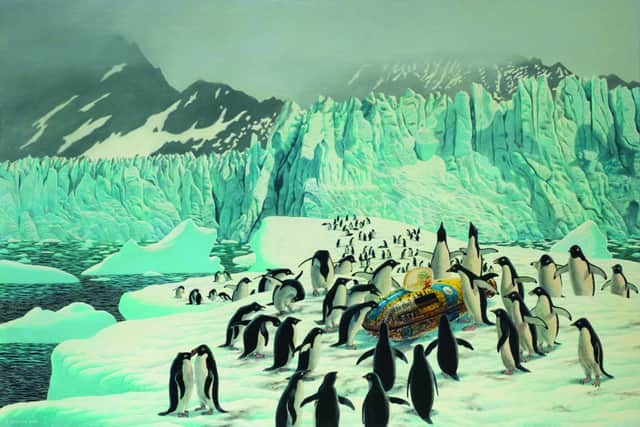

A toy submarine found by Reinhard Behrens on a beach in 1974 now sits in a glass case at the Scottish Gallery. The artist, who grew up in Germany but has made his home in Scotland since the mid 1970s, has painted the submarine – often much larger than life – in vistas from all over the world: peered at by penguins in the Antarctic, towed by camels in the desert, strapped to the back of a yak in the Himalays, floating in the canals of Venice.
Welcome to Naboland (the name came from a cargo ship he glimpsed in a Turkish newspaper in 1975), a parallel world, perhaps, and in the best tradition of imagined worlds, a lens through which to look at our own. It has been the context and the inspiration for five decades of paintings, drawings, prints and installations, and the well shows no sign of running dry. Most of the work in this exhibition has been made in the last three years.
Here, we find the submarine parked at the foot of the Buachaille Etive Mòr, among the standing stones at Calanais, in the ruins of Skara Brae. It’s also among lolling walrus in the Arctic, and in what looks like a family group photograph from an undetermined time, somewhere in South East Asia.
The large paintings are unfailingly impressive, but so dazzlingly photoreal they almost deflect our gaze. This is, perhaps, part of the conceit - a fiction which is more real than reality. For me, where Behrens’ work becomes truly extraordinary is in his drawings and, by extension, his etchings.
Here, the cataloguing, documenting, museum-like quality of Naboland comes to the fore. For there have been countless more found objects since the submarine: shells, driftwood, moccasins, hanks of rope, a teddy bear separated from its head, objects which have been kept (many of them are here, in a set of museum drawers) and placed in drawings which are themselves collections, a kind of archaeology of this imagined land.

Naboland is created with such care and skill, with a liberal strand of dry humour and an undertow of climate-consciousness, it becomes not so much another world as a singular gaze turned on the world in which we live. The submarine’s tiny pilot is, perhaps, the intrepid explorer trying to make sense of us.
There are risks involved in making work like this. It might make us smile to see the toy sub, for example, hauled up in a Venice boatyard for its winter MOT, but that’s no reason to dismiss it as quirkiness. And those who wonder why Behrens keeps adding toy submarines to perfectly good landscape paintings are missing something too. The submarine is the object which opened the door to the imagination for him and, if we let it, it might do the same for us.
A visit to the Behrens’ family home in Pittenweem was enough to convince the Scottish Gallery’s Christina Jansen that the exhibition needed to include the whole family. While Naboland is upstairs, downstairs is home to a collection of works by Behren’s wife, Margaret Smyth, and daughter Kirstie Behrens, who are both artists, and son David Behrens, a musician and composer who also makes art.
Smyth’s paintings open up a different kind of imaginative space: her ballet dancers, travelling players, circus performers, set against natural landscapes of mountains, forests and beaches are beautifully lit, quietly melancholy and always slightly magical. Some of the newest have offshore windfarms and industrial buildings in their backgrounds.
Kirstie Behrens is a superb printmaker, and has a show-within-a-show here called Etched Landscape. Like Reinhard, she has an eye for detail, and her work explores mountains in Glencoe and Assynt, coastlines in Fife, and trees just about everywhere. If Smyth’s magic lies in colour, and the way a picture is lit, hers is in draughtsmanship and in the trick of knowing when to stop.
David Behrens, who learned to build things with his father from an early age, moved on to mechanics and automata, and later to making mobiles, influenced by the work of Alexander Calder. His works are delicately minimal, bright geometric shapes on a structure of fine wires which balance and spin. Now studying in London for a masters degree in composing for film, he also combines them with music.

A fascination with exploration, particular of the polar regions, was an early part of the story of Naboland, and a similar fascination seems to fire Michael Durning’s exhibition, Scotlanarctica, currently at Milngavie’s Lillie Art Gallery, with plans to tour in the coming years.
Behind this, however, lies the remarkable true story of Scottish polar explorer William Speirs Bruce, who was refused a place on Robert Falcon Scott’s ‘Discovery’ expedition and went on to found his own Scottish National Antarctic Expedition (1902-4). His ship, SY Scotia, established the Antarctic’s first research station, and was the first to record scientifically water temperatures which are still used as a baseline today.
Mission complete, he sailed safely back to Scotland, only to have his achievements eclipsed by the tragic story of Scott’s race to the Pole. His story leads on to those of other polar Scots: Colin Archer, the engineer who built Amundsen’s ship, Harry McNish, the ships carpenter from Port Glasgow who was on Shackleton’s Endurance, not to mention the hundreds of whalers and seamen who were regulars in the southern oceans and left no record in history.
All of this is so interesting it’s in danger of upstaging the paintings, which would be a grave mistake. Durning is a fine landscape painter who uses colour and expressive brushstrokes to draw out the drama and strangeness in a place, and these are fine skills to bring to the Antarctic, with which we’ve become almost over familiar through photographs and television, even though most of us have never been there. He began, during lockdown, to paint inspired by Speirs Bruce’s photographic archive, now owned by Glasgow and Edinburgh Universities.
The more daring his interpretations, the better, playing with dramatic contrasts of light and dark in a painting like Evening Light Over the Scotia Arc, or lighting a sky gold, or lilac, or even a near-fluorescent green. At their best, his paintings make these landscapes strange again, and grand, and awe-inspiring, and surely this is what they are.
Reinhard Behrens: 50 Years of Naboland runs until 25 October; Michael Durning: Scotlantartica until 30 October
The Scotsman’s arts newsletter is now sent twice a week - subscribe today