
Art reviews: Photo Dalkeith | Matthew Arthur Williams
Set against the elegant interiors of Dalkeith Palace, Photo Dalkeith is an exhibition of the highest calibre, writes Susan Mansfield
Photo Dalkeith, Dalkeith Palace ★★★★
Matthew Arthur Williams: In Consideration of Our Times, Stills, Edinburgh ★★★
Scotland has punched above its weight when it comes to photography since the days of Hill and Adamson, and various events and projects have surfaced over the years to celebrate that connection. The latest is Photo Dalkeith, which launched last year in the splendid (and highly photogenic) location of Dalkeith Palace.


This year’s iteration, curated by Julie Lawson, former chief curator at National Galleries Scotland: Portrait, features work by 17 photographers born in or based in Scotland, including some of the field’s top practitioners. Grouped around the theme of Nature and Nurture, their work unfolds through the palace with each of them allocated one elegant room apiece.
The show begins by connecting the theme to the palace with a selection of photographs from the Buccleuch family album taken on the estate in 1890, interspersed with photographs by the current Earl, Walter Dalkeith, who is a landscape photographer, very likely taken in the same woods.

Next comes Robin Gillanders with a body of work made at Ermenonville in a garden designed according to the principles of Enlightenment-era philosopher Jean-Jacques Rousseau. The writer spent the final weeks of his life there and was buried there, although his body was later exhumed to be taken to the Pantheon in Paris as a hero of the Revolution.
There are ten beautiful black and white images, described as “Ten Walks” in keeping with the chapters of his final book, Reveries of the Solitary Walker. Each is accompanied by some of Rousseau’s words. They are joined by a small group of Gillanders’ photographs of Ian Hamilton Finlay’s garden, Little Sparta, which he has been photographing since 1993, nodding to Finlay’s admiration for Rousseau.
The question which underlies much of the work here is how, and to what extent, a photograph can convey the unseen. How do photographs of a garden convey the spirit of Rousseau, or the Solway landscapes of Iain Stewart, who has been discovering links in his family history to martyred Covenanters, carry something of the persecutions which took place there?
There is a pair of images by artist Graham Fagen looking across the Atlantic Ocean from East to West and West to East, and if we know this is his intention, we see how they convey something of the complex history of that ocean as the locus of the slave trade.
Margaret Mitchell looks at the connections between people and place in her series A Gentle Awareness. Her works here are portraits of children and young people from the island of Jura captured in the wild landscape of that island, and the pictures seem to hold something of the mystery of that connection, just as Alicia Bruce’s photographs of allotment holders in Aberdeenshire carry something of the satisfaction of taking food from the soil.
David Williams, who was head of photography at Edinburgh College of Art for 27 years, presents very personal work in Close: Family Photographs, a series of images of his son Sam, beginning with his pregnant wife and ending with Sam as a young man. Again, they convey so much which is unsaid, with a tenderness and directness which feels rare. The mother-son portrait is particularly moving.
In these pictures, the skill and technique are rendered almost invisible, while for artists like Calum Colvin, the complex way in which the work is created is front and centre. He presents three large-scale images under the title The Living Hand, all of which started with the same scuptural installation. On to this, complex layers of images were projected to create Keats’ death mask, Durer’s rhinoceros and a downcast Don Quixote.
Technique is important, too, for Norman McBeath’s elegiac images of dead leaves, luminously photographed in black and white. Walter Dalkeith’s close-ups of a frozen stream in the Moffat hills have a similar luminosity, while his aerial studies of sand dunes in the Namib desert are clean forms sculpted by shadows.
Alexander Lindsay’s large-scale landscapes look like single shots until you start to think about them and realise there is much more technique at work than you first thought. In the cyanotypes of Constanza Dessain and Alexander Hamilton - their works are shown together in a kind of counterpoint - the physical technique is almost tactile.
There is room, too, for the quirky: Ron O’Donnell recreates images from Bruegel paintings with himself playing all the characters. Andy Wiener projects photographs of his ancestors on to ancient trees which existed even before these people lived to make surprising and evocative works he calls Ancestor Trees.
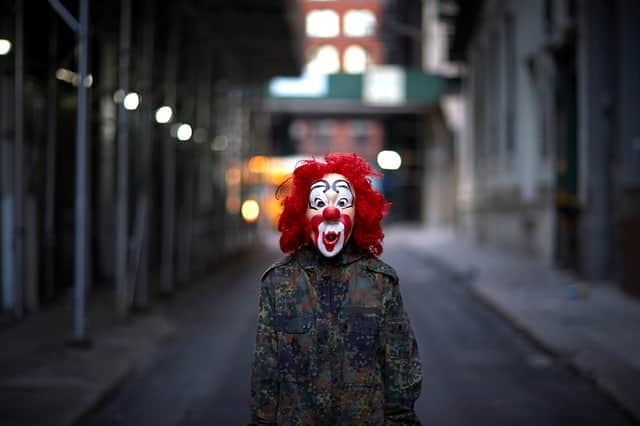
David Eustace photographs a figure in a clown mask and orange wig in the streets, parks and alleyways of Manhattan in a series begun in 2003 and completed in 2016. The camera acts like a voyeur, spotting this lonely figure in different places, making us think about how we look at people, particularly when we are in cities.
This is the first time The Clown Comes to Town has been exhibited, and it is combined here with various self portraits in a show-within-a-show called We/Only. Eustace has the largest room in Photo Dalkeith, including the aftermath of a live performance. It’s a fascinating document of the more experimental aspects of his practice.
Of course an 18th-century palace is not the same as an art gallery, and some of the works are better served than others by the lighting and the hang, but it’s well worth seeing for a peep inside this special building, and a photography show of the highest calibre.
.jpeg?trim=74,0,75,0&crop=&width=640&quality=65)
Photography is not always an easy medium for conceptual art. Perhaps because we expect to engage with it immediately, work which depends on concept rather than image can appear distant and cerebral. This is a danger with the work of an artist like Matthew Arthur Williams. He makes work about race, queerness and history, so the absence of representation is central. But how does photography show an absence?
One answer he proposes in his show In Consideration of Our Times at Stills is to make pairs of images about the same locations, one in which the figure (sometimes the artist himself) is present, and the other absent. It produces some arresting images: the artist crouches on one knee, or lies across a red velvet chair, performing aspects of presence and identity. But the overall idea feels too literal.
A welcome further layer is added by a 21-minute film, Another Allegory, inspired by the relationship between composer Julius Eastman and poet R Nemo Hill. Eastman dedicated his unusual, difficult Second Symphony to Hill after their break-up. The film is episodic, atmospheric, not unlike a musical composition, with themes and refrains, particularly the words: “I was just thinking about you.”
In this way, it recovers a story from history which is then given shape by the imagination. It seems to manage to be both a celebration of a relationship and an elegy for its passing. It is about this break-up, but perhaps also about many break-ups. Like so much of the work at Photo Dalkeith, it shows how the photographic image - still or moving - can conjure and suggest that which is unsaid.
Photo Dalkeith until 5 October (open Friday-Sunday, more information at https://www.dalkeithcountrypark.co.uk/event/photodalkeith/); Matthew Arthur Williams until 18 October
The Scotsman’s arts newsletter is now sent twice a week - subscribe today
Comments
Want to join the conversation? Please or to comment on this article.