
Art reviews: Paula Rego | Ten Modern Scottish Masters | Jim Dunbar
Paula Rego’s literature-inspired images offer unexpected interpretations of well-known stories, yet they are also entirely in keeping with what lies behind the words, writes Susan Mansfield
Paula Rego: Visions of English Literature, Dick Institute, Kilmarnock ★★★★★
Border Crossings: Ten Modern Scottish Masters, The McManus, Dundee ★★★★
Jim Dunbar: An Appreciation, Scottish Arts Club, Edinburgh ★★★★
Sometimes you stumble on a breathtaking exhibition where you don’t expect one, like a show of Paula Rego’s prints at the Dick Institute in Kilmarnock. Rego was an outstanding draughtswoman and seemed to find a joy and spontaneity in printmaking. This show, by Hayward Touring, consists of three expansive series inspired by literature.

Rego’s unique vision is anything but illustrative - even when she was commissioned to create illustrations. Stories and poems became a jumping-off point to do what she wanted to do. This is particularly the case in the largest series in the show inspired by Jane Eyre. She found in Charlotte Bronte’s gothic romance a live connection to aspects of her own story. Some of her pictures speak directly to the book, others are set in her own family home.
For Rego, Jane Eyre is the story of two women: Jane and Bertha, Rochester’s marginalised first wife. It’s about secrets, the unequal dynamic between the sexes, and the burden of expectation and scrutiny which falls upon women, as much from other women as from men.
She is a master at capturing nuanced emotions, as good at complex group scenes as she is at focusing on a single figure, and capable of creating multiple dramas within a single frame. They are not always easy viewing, but they are very, very good.
Nursery rhymes proved a trigger for her free-ranging imagination. After illustrating a collection for her granddaughter in 1989, she began a series of etchings with an adult audience in mind. As Angela Carter does with fairy tales, she excavates a world of myths and archetypes, big emotions and, at times, brutality. Her Three Blind Mice seem to dance around in agony, their tales having been cut off with a carving knife as the rhyme describes. The cradle on the treetop in Rock-a-Bye Baby really does look precarious, and the watchful mother knows it.
In Baa Baa Black Sheep, a young woman stands before an enormous, stately, black sheep, plucking coquettishly at its fleece. The spider edges closer to Miss Muffet. Rego’s take is entirely fresh, yet the dark imagination seems entirely in keeping with what lies behind the words.
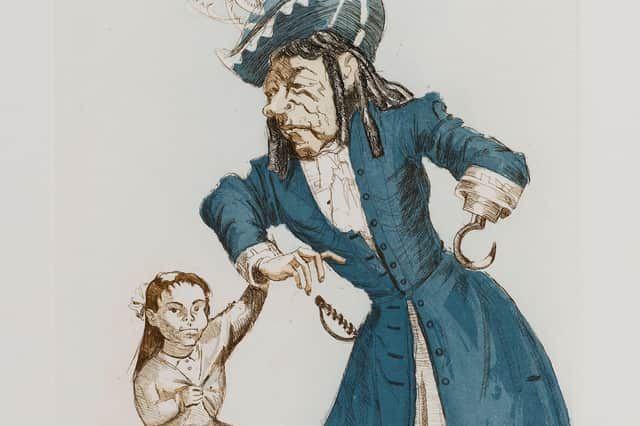
The third series is on Peter Pan, a commission for the Folio Society, another strange tale which has always been rather more than a children’s story. It’s about children becoming adults (or not), and she draws characters who move between childhood and adulthood: Peter is a boy, then an adolescent, then a proxy for the god Pan with little goat horns. Wendy is a little girl, then a competent nursemaid for the tiny Lost Boys.
Hook is a sinister, skeletal figure, but then, in a picture like Captain Hook and a Lost Boy, becomes a vulnerable old man who might be pitied as much as he is feared. Neverland is a place of innocence and the loss of innocence in so many ways.

Meanwhile, a remarkable exhibition of a very different kind is happening in Dundee’s McManus Gallery. Largely using the gallery’s own collection, for Border Crossings: Ten Modern Scottish Masters the team has brought together ten Scottish artists all of whom were important in the development of abstract art in the UK.
Most lived significant periods of their lives outside Scotland, all immersed themselves in the latest developments in art in Paris and New York. Many were celebrated in their lifetimes: Alan Davie was courted by Rothko and Jackson Pollock; William Gear caused a furore by winning a prize of £500 in 1951, roughly the price of a house in central London. Yet, not many of them are well known today.
While there are only a small number of works per artist, they have been chosen to show their developing styles: how Barns-Graham moved from detailed drawings to the spontaneous, colourful mark-making of her later years; how Robert Colquhoun came to deserve his nickname, McPicasso. Detailed biographies help to contextualise the work.
Paolozzi was an artist with many faces and there are several of them here, including a mirrored abstract sculpture and his large work Jeepers Creepers, which looks a bit like a send-up of Bridget Riley but with added objects: insects, a parrot, a pink rocket and a row of clowns.
Between them, they explore many of the faces of modernism, from the formal minimalism and restrained palette of William Scott, to artists like William Crozier and William Johnstone, who painted in abstract styles but kept a toe in landscape painting.
William Turnbull, who was born in Dundee, is nominally the centre of the show, yet remains the most elusive. A painter and sculpture, he had a career retrospective at the Tate in 1973, but there is perhaps not enough work here for the casual viewer to nail down what he was about.
The art world moved fast in the 20th century, and some of these innovators in sculpture and painting are not recognised as they should be. Though there is much more to say about all of them, a show like this reminds us of their striking and significant achievements and why we should know them better.

It’s a pleasure to see a celebration at the Scottish Arts Club (open to the public) of the work of Angus-based Jim Dunbar, who died in January 2024. An accomplished painter in oil and watercolour, Dunbar was President of the RSW until 2021 and the work here, from across his long career, is testament to his skill and ambition as an artist.
Much of the work here is landscape, often rooted in Angus, in farms, fields and coastline. Often there are traces of the human, though these are usually in retreat: old agricultural machinery, a broken gate, a tumbling drystone wall. He is a master of texture - flaking paint, rusting metal, a knotted mooring rope - but he knew when to elide as well, so the detail never becomes burdensome.
He approached his subject with a delicate touch, conjuring light and atmosphere without overdoing the poetry of an evening sky. The surprise to me in this work was the boldness of some of his compositions, sculpting the curves of land or dividing the picture with a centrally placed wall.
When illness curtailed his painting ambitions, he taught himself wood engraving and unsurprisingly excelled at that too, making his own tools when the bought ones failed to give him the level of detail he wanted. This show is a tribute to a fine man and a fine artist.
Paula Rego until 27 September; Border Crossings until 14 June 2026; Jim Dunbar until 27 September
The Scotsman’s arts newsletter is now sent twice a week - subscribe today
Comments
Want to join the conversation? Please or to comment on this article.